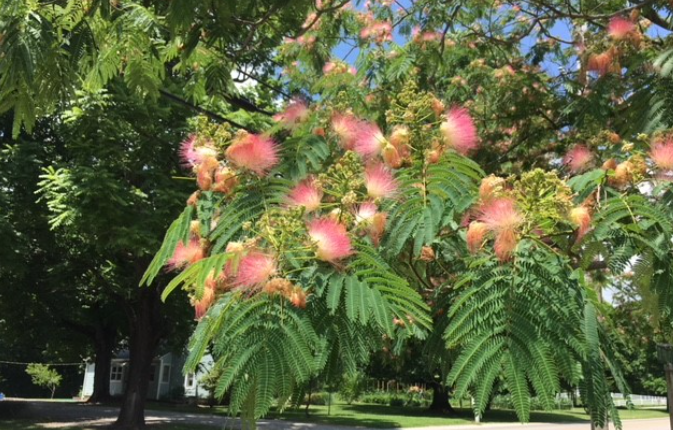
Mimosa trees are among the most recognizable ornamental flowering trees in North American landscapes, prized for their feathery, fern-like foliage and their silky, powder-puff blossoms that seem to explode outward in shades of pink, red, cream, and gold. Most mimosa trees grow quickly, often adding two to three feet of height per year, and many reach a mature size of twenty to forty feet tall with a canopy spreading just as wide, giving them a graceful, umbrella-like silhouette. This rapid growth rate, combined with their tolerance for heat, drought, poor soil, and urban pollution, has made mimosa trees a favorite for homeowners who want quick shade and season-long color without demanding maintenance.
One of the most distinctive traits shared across mimosa trees is a behavior called nyctinasty, in which the compound leaflets fold inward at night or during rainfall, as if the tree were going to sleep. This movement was first scientifically documented in the early eighteenth century and remains one of the more fascinating features that draws children and adults alike to observe these trees closely. A single mature leaf can span well over a foot and a half in length, made up of dozens of tiny leaflets arranged in a feathery, pinnate pattern that gives the entire canopy a soft, airy texture rather than a dense, heavy one.
Flowering typically begins in late spring and continues through summer, with individual blossoms lasting only a few weeks but new flushes appearing continuously across the season, often for two to three months at a stretch. The blooms are rich in nectar and are considered one of the more valuable late-summer food sources for hummingbirds, butterflies, and bees, at a time when many other flowering trees have already finished their bloom cycle. Depending on the type, flower color ranges from soft blush pink to deep raspberry red to creamy white or golden yellow, and the fragrance is often strongest in the cool of the evening.
Mimosa trees are not typically long-lived compared to oaks or maples, with many types averaging a lifespan of only ten to twenty-five years, largely due to their susceptibility to a fungal wilt disease that affects the vascular system. Despite this relatively short lifespan, mimosa trees have naturalized widely across the warmer regions of North America, from the coastal Southeast up through the mid-Atlantic states, and in some states they grow vigorously enough to be classified as an invasive species. Their adaptability to sandy, clay, and loamy soils alike, combined with a wide pH tolerance, has allowed them to spread well beyond the gardens where they were originally planted, often reseeding along roadsides, forest edges, and disturbed ground.

Types of Mimosa Trees
Pink Silk Tree
The Pink Silk Tree is the classic, most widely recognized form of mimosa, producing an abundance of bright pink, thread-like blossoms that cover the canopy through the heart of summer. Mature specimens typically reach twenty to forty feet in height with an equally wide, flattened, umbrella-shaped crown, and the wood, while fast-growing, is somewhat brittle and prone to breakage in strong wind or ice storms. This type is commonly found from the southeastern United States northward into the mid-Atlantic states, thriving in full sun along roadsides, riverbanks, and open fields, and it generally lives between ten and twenty years before succumbing to disease or storm damage.
Summer Chocolate
Summer Chocolate is instantly recognizable for its deep burgundy to chocolate-brown foliage, which darkens further during the dry heat of summer and creates a striking contrast against its soft pink blooms. This variety tends to grow somewhat smaller and more compact than the classic form, typically reaching fifteen to twenty-five feet at maturity with a slightly weeping, layered branch structure. It is commonly planted as an accent tree near patios and water features across the warmer parts of the United States and generally lives fifteen to twenty years under good growing conditions.
Chocolate Fountain
Chocolate Fountain shares the rich burgundy foliage of its Summer Chocolate relative but carries an even more pronounced weeping, cascading growth habit, with branches that arch downward toward the ground. It usually stays under twenty feet tall, making it a popular choice for smaller residential yards where a dramatic focal point is desired without the size of a full canopy tree. This type is grown throughout the southeastern and south-central United States and typically lives around fifteen to twenty years.
Rosea
Rosea, sometimes sold under a different varietal name honoring the plant collector who introduced it to Western gardens, is a smaller, bushier type that reaches only ten to fifteen feet in height. Its bright, saturated pink to red flowers are considered among the most vivid of any mimosa type, and the tree was specifically bred to tolerate drier conditions and colder winters than the standard form. It is frequently planted in containers and small gardens from the mid-Atlantic states down through the Gulf Coast, and thanks to its improved cold hardiness it often outlives other types, sometimes reaching twenty-five years.
E.H. Wilson
E.H. Wilson is closely related to Rosea and is prized for its soft pink flowers and notably compact, rounded growth habit, generally staying between twelve and eighteen feet tall. This type shows better cold tolerance than most other mimosa varieties, allowing it to be grown successfully in cooler regions where other types would struggle, including parts of the upper South and lower Midwest. It typically lives fifteen to twenty years and is a popular choice for gardeners in transitional climate zones.
Alba
Alba stands apart from most mimosa types for its creamy white flowers, a rare trait among trees that are otherwise known almost exclusively for shades of pink and red. In form and size it closely resembles the classic pink type, generally reaching twenty to thirty-five feet tall, though its wood is considered just as weak and susceptible to storm damage. Alba is found in scattered plantings across the southeastern United States, valued by gardeners seeking a lighter, more subdued color palette, and typically lives ten to eighteen years.
Charlotte
Charlotte is a rare, disease-resistant type bred specifically to withstand the vascular wilt that shortens the life of most mimosa trees, making it notably harder to find in nurseries than other varieties. It grows to a similar height as the classic form, often twenty to thirty feet, with the familiar bright pink, fragrant blossoms appearing through summer. Because of its improved disease resistance, Charlotte can live considerably longer than typical mimosa trees, sometimes exceeding twenty-five years, and it is occasionally planted in the southeastern United States by gardeners specifically seeking a hardier specimen.
Pendula
Pendula is defined by its strongly weeping growth habit, with branches that cascade downward from a central trunk, giving the tree a graceful, fountain-like appearance even before it flowers. This type stays notably compact, usually under ten feet tall, making it well suited to small gardens or as a specimen planting near a patio. It is grown throughout the warmer regions of North America and, like other weeping cultivars, typically lives fifteen to twenty years.
Umbrella
Umbrella is among the largest mimosa types available, capable of reaching forty feet in height with a canopy that spreads just as wide, forming the broad, flat-topped silhouette that gives the variety its name. It produces the same silky pink blossoms as the classic type but on a considerably larger frame, making it a popular choice where substantial shade is the primary goal. This type is found across the southeastern United States and generally lives between ten and twenty years given its rapid growth rate and brittle wood.
Flame
Flame is grown for its exceptionally vivid, fiery red-pink blossoms that stand out even at a distance, offering a bolder color than the soft pastel tones of the classic pink type. It reaches a moderate mature height of twenty to thirty feet with the same fine, feathery foliage typical of the species. Flame is cultivated in warmer pockets of the United States, particularly the Southeast, and generally lives fifteen to twenty years.
Merlot Majik
Merlot Majik combines dark, wine-colored foliage with bright pink flowers, similar in effect to the Summer Chocolate type but bred for improved branching structure and a more uniform, rounded canopy. Mature trees typically reach eighteen to twenty-five feet tall, making it a manageable size for residential landscapes. It is grown across the southern and mid-Atlantic United States and generally lives fifteen to twenty years.
Tryon
Tryon is a lesser-known cultivar valued for its reliable, heavy bloom production and sturdy branching, which makes it somewhat more wind-resistant than other mimosa types. It grows to a similar height as the classic form, often twenty to thirty feet, with the same soft pink, fragrant flowers. Tryon is planted in scattered nursery collections across the southeastern United States and typically lives fifteen to twenty years.
Union
Union is another lesser-common cultivar, distinguished mainly by a more upright, columnar growth habit compared to the broad, spreading canopy typical of most mimosa trees. It generally reaches twenty to twenty-five feet in height and produces the familiar pink, thread-like blossoms through the summer months. This type is occasionally found in specialty nurseries in the southeastern United States and typically lives fifteen to twenty years.
Durazz
Durazz is named for the botanist credited with the first formal description of the species and is grown mainly as a genetic reference type in botanical collections rather than as a common ornamental. It reaches heights similar to the classic form, twenty to thirty-five feet, with typical pink flowers and fine, feathery leaves. It is rarely found outside specialty and university plant collections in the United States and, like most mimosa types, generally lives ten to twenty years.
Silver Wattle Mimosa
Silver Wattle Mimosa is known for its abundant clusters of fragrant, golden-yellow, puff-like blossoms that appear in late winter, far earlier than most other mimosa types, and for its soft, silvery-gray, finely divided foliage. In its adopted range this type can grow remarkably fast, adding close to three feet of height a year during its first five years, eventually reaching twelve to twenty-five feet in cultivated settings. It has naturalized along the mild coastal regions of the Pacific Northwest and parts of the Southeast, and while individual trees are relatively short-lived, generally fifteen to twenty years, its vigorous root system allows it to persist and spread in a given area for much longer.
Cootamundra Wattle Mimosa
Cootamundra Wattle Mimosa produces a spectacular flush of golden yellow flowers at the end of winter, set against fine, blue-green foliage that gives the tree a soft, silvery cast year-round. It typically grows fifteen to twenty-five feet tall with a light, airy canopy, and it establishes and flowers quickly, often blooming within its first two to three years. This type is grown in warmer coastal pockets of the United States and generally lives around fifteen to twenty years.
Purple Leaf Wattle Mimosa
Purple Leaf Wattle Mimosa is a striking foliage variety that carries deep violet-purple leaves for roughly half the year before shifting to green, creating a dramatic seasonal color change alongside its golden yellow blossoms. It reaches a similar mature size to its silver-leaved relatives, generally fifteen to twenty feet tall, and prefers the same well-drained, sunny conditions. It is grown as a specialty accent tree in mild coastal regions of North America and typically lives fifteen to twenty years.
Four Seasons Mimosa
Four Seasons Mimosa is notable for its unusually long bloom window, flowering intermittently from late spring all the way through autumn rather than in one concentrated burst like most mimosa types. It tends to bloom somewhat more sparsely at any given time but compensates with the sheer duration of its flowering season, and it typically reaches fifteen to twenty feet tall. It tolerates drought exceptionally well and is grown in warm, dry regions of the southern United States, generally living fifteen to twenty years.
Golden Dream Mimosa
Golden Dream Mimosa is a compact type bred specifically for container growing, featuring soft, bluish-green feathery foliage and the same clusters of fragrant yellow flowers typical of its relatives. It rarely exceeds ten to twelve feet in height, making it one of the more manageable mimosa types for a small yard or patio setting. This type is grown in mild, frost-free pockets of the United States and generally lives twelve to eighteen years given its more contained growth habit.
Prostrate Mimosa
Prostrate Mimosa has a distinctive low, creeping growth habit rather than an upright tree form, making it useful as a groundcover for slopes and banks rather than as a shade tree. It generally spreads several feet wide while staying under two to three feet tall, with the same fine, silvery foliage and yellow puff-like blossoms as its upright relatives. It is planted in warm coastal regions of North America for erosion control and typically persists for ten to fifteen years.
Le Gaulois Mimosa
Le Gaulois Mimosa is a hybrid type bred primarily for cut flower production, valued for its dense clusters of sulfur-yellow blossoms that hold their color and form well after cutting. It typically reaches twelve to eighteen feet tall, with narrow, silvery-gray foliage that provides an attractive backdrop to the flowers. This type is grown in mild coastal nurseries in North America and generally lives twelve to eighteen years.
Mirandole Mimosa
Mirandole Mimosa is a vigorous, dark-leaved type that blooms earlier than most other mimosa varieties, often producing its golden flowers by the end of December in the mildest climates. It grows notably tall for a cultivated type, sometimes reaching twenty-five feet, with a dense, upright habit. It is found in specialty plantings in the warmest parts of North America and typically lives fifteen to twenty years.
Sensitive Plant Mimosa
Sensitive Plant Mimosa is grown less for its small, fluffy pink flowers than for its remarkable ability to fold its leaflets shut within seconds of being touched, a defense mechanism that has made it one of the most famous curiosity plants in the world. Unlike the larger tree types, this one grows as a low, sprawling shrub rarely exceeding two to three feet in height, and in frost-free climates it can behave as a short-lived perennial. It has naturalized in the warmest parts of the southeastern United States, including Florida, and typically lives only one to three years outdoors, though it can be kept much longer as a houseplant.
Sunshine Mimosa
Sunshine Mimosa is a low-growing, mat-forming groundcover type native to parts of the southeastern United States, producing round, pink, powder-puff flowers held just above a carpet of fine, fern-like foliage. It typically spreads several feet wide while staying only a few inches tall, making it a popular choice for erosion control and pollinator gardens rather than shade. This type is commonly found in sandy, open sites across Florida and neighboring Gulf Coast states and, as a spreading perennial groundcover, can persist in a given planting for well over a decade.
Jurema Mimosa
Jurema Mimosa is a large shrub to small tree type native to warmer parts of the Americas, known for its dense, spiny branches and fluffy white to pale pink flower clusters that appear in the spring. It typically grows ten to twenty-five feet tall in favorable conditions, with a broad, thicket-forming habit when left unpruned. In North America it is found mainly in the warmest southern regions and typically lives fifteen to twenty-five years, often forming dense colonies through vigorous root suckering.
Powderpuff Mimosa
Powderpuff Mimosa is a wetland-adapted type recognized by its bright pink, fluffy flower heads and its tolerance for consistently moist or seasonally flooded soil, conditions that few other mimosa types can handle. It typically grows as a shrubby, multi-stemmed plant six to twelve feet tall, though it can reach greater heights in ideal growing conditions. This type is found along waterways, wetland margins, and disturbed moist ground in the warmest parts of the southern United States, and it typically lives ten to fifteen years, spreading readily by seed in favorable habitat.