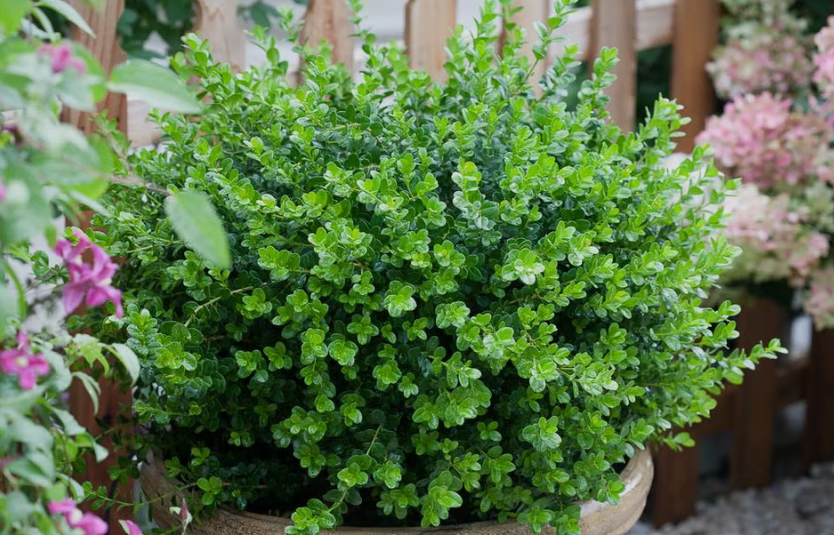
Balearic boxwood is a large-leaved Mediterranean boxwood that grows wild on rocky hillsides in Spain, North Africa and nearby islands. It looks like a bolder, glossier version of the common boxwood, with bright green leaves up to about 1.5 inches long. In gardens, it grows into a handsome evergreen shrub or small tree that thrives in warm, dry climates.
This boxwood is rare in North American gardens, but it is drawing new attention. Research suggests it may be the most resistant boxwood species to boxwood blight, a disease that has devastated boxwood plantings in Europe and the United States. That makes it valuable both as a garden plant and as a parent for breeding tougher boxwoods.
Botanical Classification
Balearic boxwood belongs to the box family, a small group of evergreen shrubs that also includes pachysandra and sweet box. It is a close relative of common boxwood, the familiar hedge plant of European and American gardens. The two species share many features, and in parts of Spain they sometimes cross in the wild.
It is often called Spanish boxwood, Minorca box or giant box tree. Its larger leaves, more vigorous growth and greater tolerance of drought set it apart from common boxwood.
Brief History
Balearic boxwood is native to the western Mediterranean. It grows on the Balearic Islands of Mallorca and Cabrera, in scattered populations in eastern Andalusia in southern Spain, on the island of Sardinia, and in parts of Morocco and Algeria. Some sources also report it from Turkey. Despite its name, it has disappeared from the island of Menorca.
It grows mainly in mountain scrub and open woods on limestone soils, often where the air stays fairly humid. Like many Mediterranean plants, it can resprout after wildfires. Its wild populations are small and scattered, and it is protected in parts of its range.
In recent years, wild populations have faced serious threats. Boxwood blight and the box tree moth have reduced some populations by up to 90%, especially in isolated stands. Conservation groups in Europe now consider it a species of concern.
Identifying Characteristics
The most noticeable feature of Balearic boxwood is its large leaves. They are oval to oblong, thick and leathery, and up to about 1.5 inches long, larger than those of common boxwood. They are bright green and glossy above and paler underneath, sometimes with a slight notch at the tip. In some conditions, the leaves take on reddish or yellowish tints.
In gardens, it usually grows into a dense, upright shrub or small tree about 10 feet tall. In the wild and in ideal conditions, older plants can grow considerably taller. It has a somewhat conical shape and grows faster than most boxwoods.
In spring, it produces small clusters of yellowish-green flowers among the leaves. They are not showy, but they are fragrant and attract bees. Small seed capsules follow in summer. All parts of the plant are toxic if eaten.
Landscape Uses
Balearic boxwood makes a bold evergreen screen or informal hedge in warm climates. Its larger leaves give it a coarser texture than common boxwood, so it suits larger spaces and naturalistic gardens. It can also be grown as a small specimen tree.
It works well in Mediterranean-style gardens alongside olives, rosemary, lavender and cistus. It is a good choice for coastal gardens, since it tolerates wind and some salt spray. In large containers, it makes an attractive accent for patios and courtyards.
It can be clipped into hedges and simple shapes, though its large leaves make it less suited to fine topiary. Like other boxwoods, it is deer-resistant.
Growing Considerations
Balearic boxwood is generally hardy in USDA zones 8 to 10, and some growers rate it to zone 11. It is less cold-hardy than common boxwood and may suffer damage in hard freezes. In colder areas, it is best grown in a container that can be moved to a sheltered spot in winter.
It grows best in full sun to partial shade. In very hot, dry regions, some afternoon shade helps keep its leaves healthy. It handles heat and drought better than most boxwoods once established.
It prefers well-drained soil and does especially well in limestone or slightly alkaline soils, reflecting its natural habitat. Like all boxwoods, it can develop root rot in waterlogged ground. A thin layer of mulch helps keep its shallow roots cool, but mulch should not touch the stems.
Water young plants regularly until they are established. After that, occasional deep watering during long dry spells is usually enough. It grows best where the air is not too dry, so coastal and Mediterranean-type climates suit it well.
Pruning and Care
Balearic boxwood tolerates pruning well and can be kept as a hedge or shaped into a small tree. Prune in late spring after the first flush of growth hardens. Avoid heavy pruning in late summer, which can trigger tender growth that may be damaged by frost.
Because it grows faster than many boxwoods, it may need trimming once or twice a year to keep a neat shape. Thinning a few interior branches lets light and air into the plant and helps keep it healthy.
Light fertilizer in spring can help young plants establish. Mature plants usually need little feeding, especially in good soil.
Pests and Diseases
Balearic boxwood is notable for its resistance to boxwood blight. In tests of many boxwood species and cultivars, it showed some of the strongest resistance of any boxwood. This has made it of great interest to plant breeders hoping to develop blight-resistant hybrids.
It is still vulnerable to other problems. The box tree moth, an invasive pest from Asia, has caused heavy damage to wild populations in parts of its range. Its caterpillars can strip plants of their leaves.
Root rot can occur in poorly drained soil. Boxwood leafminer, psyllids and spider mites may also appear, though they are generally less of a problem than on some other boxwoods. In cold areas, frost damage can cause leaf browning and dieback.
Where to Find Balearic Boxwood
Balearic boxwood is rarely sold in North America. It is mostly offered by specialty nurseries and grown by collectors, botanical gardens and boxwood enthusiasts. It is more widely available in Europe, especially in Mediterranean countries and the United Kingdom.
Because it is protected in parts of its native range, plants should only be bought from nurseries that grow them from cultivated stock. It can be propagated from seed or cuttings.
Balearic Boxwood vs. Common Boxwood
Balearic boxwood and common boxwood look similar, but there are clear differences. Balearic boxwood has larger, glossier and brighter green leaves and grows faster and more upright. Common boxwood has smaller leaves, a denser habit and a stronger scent.
Balearic boxwood handles heat and drought better and is much more resistant to boxwood blight. Common boxwood is far more cold-hardy and better suited to formal hedges and fine topiary. For warm, dry gardens, Balearic boxwood can be a strong alternative.
Sources
EUFORGEN, “Buxus balearica: Balearic Boxwood”
Royal Horticultural Society, “Buxus balearica: Balearic Box”
University of the Balearic Islands, “Buxus balearica: Virtual Herbarium”