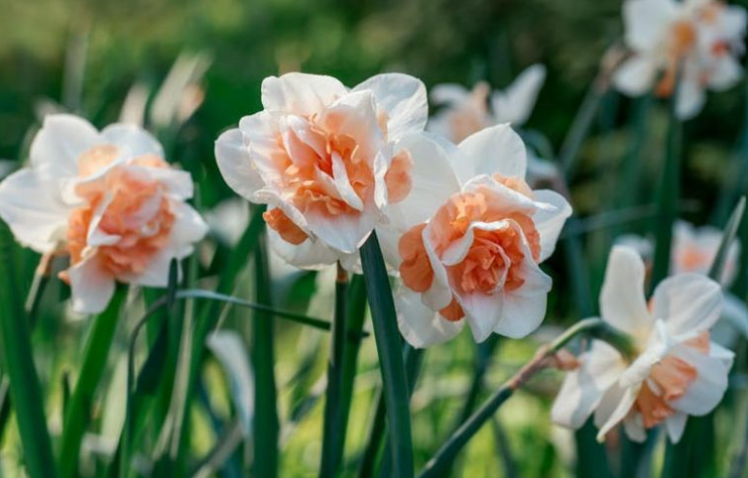
Double daffodils have a way of making you stop and look twice. Instead of the familiar arrangement of six outer petals surrounding a single trumpet or cup, these flowers are packed with extra petals, folded segments, or doubled corona parts that give them a fuller, almost rose-like appearance. Some look neat and rounded, while others are wonderfully untidy, with layers of petals spilling out from the center. Once you see a good clump of double daffodils in full bloom, it is easy to understand why they have become favorites among gardeners and flower enthusiasts.
There is an enormous amount of diversity within the genus Narcissus. The Royal Horticultural Society maintains the International Daffodil Register and classifies cultivated daffodils into 13 horticultural divisions based mainly on flower characteristics. Double Daffodils belong to Division 4, which includes cultivars where the perianth segments, the corona, or both are doubled. Interestingly, the RHS notes that Double Daffodils can produce one or more flowers on a stem, so even within this single division there is considerable variation in flower form.
What I particularly like about double daffodils is that they can change the character of a spring planting. A traditional yellow trumpet daffodil gives you that unmistakable spring look, while a double variety can feel more ornamental and almost theatrical. Some are strongly scented, some produce several flowers per bulb, and others have large blooms with contrasting colors tucked into the center. Below, I’ve selected 15 Double Daffodils worth growing, followed by practical advice on planting, flowering, containers, cutting and helping the bulbs return for another season.
What Are Double Daffodils?
Double Daffodils are Division 4 in the international horticultural classification of Narcissus. Unlike single-flowered daffodils, they have additional flower parts, which may come from doubled petals, a doubled corona, or a combination of both. Some varieties have a dense center of extra petals, while others look more like layered rosettes.
This makes the group particularly interesting because “double” does not describe one particular appearance. Two Division 4 cultivars can look completely different from one another. One might have broad white petals surrounding a small orange center, while another may be filled with yellow and orange segments from the outside almost all the way into the middle.
The RHS also lists many Double Daffodils for borders, containers, informal gardens, underplanting around shrubs and roses, and cut flowers. They generally prefer fertile, well-drained soil and a position in full sun or partial shade.
15 Double Daffodils to Grow in Your Garden
1. Tahiti
‘Tahiti’ is one of the easiest Double Daffodils to recognize because of its strong golden-yellow coloring and warm orange center. The flowers can reach around 10 cm across, with deep golden-yellow outer segments surrounding smaller, darker orange inner segments. The plants grow to roughly 45 cm tall, giving the flowers enough height to stand out in a spring border.
I would choose ‘Tahiti’ when I wanted a double daffodil that still felt unmistakably traditional. The colors are bright and warm, but the extra layers make the flower considerably fuller than a standard trumpet or cup-shaped daffodil. It works especially well when planted in groups, and its strong coloring pairs naturally with other yellow, orange and blue spring flowers.
2. Bridal Crown
‘Bridal Crown’ has a completely different personality from ‘Tahiti’. Instead of large golden flowers, it produces smaller, fully double creamy-white blooms with yellow inner segments. The RHS describes it as very fragrant, with flowers around 4 cm across and stems reaching approximately 50 cm. It flowers in mid-spring.
The fragrance is one of the reasons I would place this variety somewhere close to a path, patio or seating area rather than at the far end of the garden. Its smaller flowers also make it useful for informal plantings, containers and cottage-style borders. A few clumps can create a soft, almost bridal effect when the flowers open together.
3. Cheerfulness
‘Cheerfulness’ is an old favorite for gardeners who want both double flowers and fragrance. It produces clusters of fragrant double white flowers with cream and yellow segments toward the center, and the plants reach around 40 cm tall. The RHS lists it as a Division 4 cultivar and an Award of Garden Merit plant.
The fact that the flowers arrive in clusters gives ‘Cheerfulness’ a slightly different appearance from doubles that produce one dominant bloom. I particularly like that softer, fuller effect for informal gardens. It is also a useful choice for cut flowers because several blooms can develop from the same planting, creating a fuller arrangement.
4. Replete
‘Replete’ is one of the most attractive choices if you prefer delicate colors. Its flowers can reach around 10 cm across, with white outer petals surrounding crumpled pale pinkish-orange corona segments in the center. The plants grow to approximately 45 cm tall.
The pinkish-orange coloring gives this daffodil a much softer appearance than bright yellow doubles. I would use it in a border with white, blush pink, peach or lavender flowers, where its unusual center can become part of a more coordinated spring color scheme. It is also well suited to containers and cut-flower gardens.
5. Sir Winston Churchill
‘Sir Winston Churchill’ is a fragrant double daffodil that produces several creamy-white flowers on stems reaching around 40 cm. Orange segments are interspersed among the inner flower parts, giving the blooms a warm contrast against the pale outer petals.
This is a good example of why double daffodils are worth examining closely. From a distance, the flowers appear predominantly creamy white, but as you get closer, the orange sections become much more noticeable. I would plant it near a walkway or seating area where both its appearance and fragrance can be enjoyed.
6. Double Fashion
‘Double Fashion’ produces large double flowers, reaching approximately 10 cm across. The broad outer petals are pale yellow, while rich orange, frilly corona sections are mixed through the center. The plants grow to around 40 cm tall.
The frilled orange center gives this variety a particularly decorative appearance. It would look at home in a traditional flower border, but I also think it is an excellent candidate for containers because the flowers deserve to be viewed at close range. Planting several bulbs together can create a striking mound of color in spring.
7. Double Event
‘Double Event’ is a softer-looking double daffodil with light lemon-yellow flowers that can reach around 9 cm across. Its flowers have flat, overlapping perianth segments, giving them a broad and layered appearance rather than a tightly packed center. The plants can reach about 50 cm tall.
This is a useful choice if you like the fuller form of double daffodils but do not want an extremely elaborate flower. The pale lemon color is easy to combine with other spring bulbs, and the relatively tall stems allow the flowers to hold their own in a mixed border.
8. Double Itzim
For smaller gardens, ‘Double Itzim’ is especially interesting. It is a compact daffodil reaching around 25 cm, with flowers approximately 9 cm across. The flowers have layers of narrow light-yellow outer petals, smaller incurved petals toward the center and frilly orange corona sections.
That combination of a short plant and relatively large flower makes it useful where space is limited. I would consider it for containers, rock gardens, the front of borders or smaller courtyard gardens. The lower growth habit also means the flowers can be appreciated without needing to plant them at the back of a bed.
9. Acropolis
‘Acropolis’ is one of the larger and more dramatic Double Daffodils. The RHS describes it as reaching around 70 cm, with large flowers up to approximately 11 cm across. The creamy-white petals are mixed with short orange corona segments in the center, creating a strong contrast.
This is the type of daffodil I would give a little extra room. Tall stems combined with large flowers can make ‘Acropolis’ an excellent focal point in a spring border. It can also be used for cut flowers, where the large blooms have enough visual weight to stand out in an arrangement.
10. Delnashaugh
‘Delnashaugh’ has an unusually soft and romantic appearance. Its double flowers can reach around 10.5 cm across and combine broad creamy-white outer petals with narrower inner petals and soft peach-colored corona sections. The RHS describes it as a late-spring flowering cultivar reaching approximately 45 cm tall.
The peach coloring makes it particularly appealing if you are trying to create a more sophisticated spring palette. Rather than combining it with strong yellow flowers, I would use it with whites, soft pinks and other pastel bulbs. Because it flowers later than some other daffodils, it can also help extend the season.
11. Obdam
‘Obdam’ is a lovely choice for an almost entirely white double-flowered display. Its outer petals are white and may show a slight green tint, while the central corona segments open yellow and gradually fade to white. It flowers from mid to late spring and reaches around 40 cm.
That gradual change is part of what makes this variety interesting. The flowers can begin with a little more contrast and become increasingly pale as they mature. I would use ‘Obdam’ in a white garden, beneath deciduous shrubs or in a container where the subtle color changes can be seen at close range.
12. Westward
‘Westward’ produces double flowers with broad white outer petals and smaller white inner petals mixed with short, frilly bright-yellow corona sections. The plant grows to around 45 cm and is suitable for borders, containers, informal gardens and cut-flower use.
The bright yellow center prevents the flowers from becoming too visually pale, while the white outer petals keep the overall effect fresh. I would use this variety where you want the softness of white flowers but still want a clear yellow focal point in the center.
13. Beauvallon
‘Beauvallon’ is particularly interesting because it can produce two or three flowers per bulb. Its blooms are around 9 cm across, with bright greenish-yellow petals and orange-red corona segments interspersed through the center. It flowers in early to mid-spring and reaches about 40 cm.
The multiple flowers give this cultivar a fuller appearance in the garden, particularly when several bulbs are planted together. The orange-red center also makes it more colorful than many of the cream and white doubles. I would use it where you want a lively spring display rather than a subdued pastel effect.
14. Pencrebar
‘Pencrebar’ is another Division 4 cultivar suited to a wide range of garden settings. The RHS recommends it for borders, containers, informal gardens, banks and slopes, as well as for underplanting roses and shrubs. Like other double daffodils, it benefits from well-drained soil and should be allowed to die back naturally after flowering.
I find cultivars like this particularly useful when planning a mixed spring planting because they do not have to be restricted to one specific type of garden. A double daffodil can look equally comfortable in a cottage border, a patio container or beneath a shrub, provided the planting conditions are right.
15. My Story
‘My Story’ is a striking modern-looking double daffodil with strong stems reaching around 45 cm. It produces a large flower with broad white perianth segments surrounding narrower white inner segments mixed with ruffled double sections of salmon-pink corona. It is described by the RHS as a mid-season cultivar.
The salmon-pink center makes this one of the varieties I would choose when I wanted the daffodils to become a real focal point. The combination of white and pink works beautifully with other pastel spring flowers, and the strong stems make it useful for a cut-flower planting as well as an ornamental border.
Why Grow Double Daffodils?
The biggest attraction is obviously the flower itself. Double daffodils have more petals and flower parts than the classic single forms, so they often look fuller, more textured and more ornamental. Depending on the cultivar, they can resemble miniature peonies, carnations or layered rosettes.
But appearance is not their only advantage. Double daffodils are still daffodils, meaning they retain the basic qualities that make Narcissus so popular: they are bulbous perennials, generally easy to grow, and capable of returning for years under suitable conditions. The RHS describes daffodils as long-lived, low-maintenance spring bulbs suitable for borders, containers and grass.
Are Double Daffodils Perennials?
Yes. Double daffodils are perennial bulbs and can return each spring when grown in appropriate conditions. Once established, they can remain in the ground for years rather than requiring annual replacement.
This is one of the reasons I think they are worth giving a permanent place in the garden. A planting that looks modest in its first season can gradually become more impressive as the bulbs establish and produce offsets. If flowering becomes weaker because a clump has become overcrowded, the bulbs can be lifted and divided after the foliage begins to die back.
How to Plant Double Daffodils
The best time to plant daffodil bulbs is generally in autumn. The RHS recommends planting daffodils in September and notes that they perform best in fertile, well-drained soil with plenty of sun, although they can tolerate some light shade.
For Double Daffodils specifically, RHS plant profiles commonly recommend planting bulbs at around one and a half to two times their own depth in autumn. However, planting depth can vary according to bulb size and local conditions, so following the supplier’s instructions is sensible.
Avoid planting the bulbs in areas that remain waterlogged. Good drainage is important, especially during winter when dormant bulbs can sit in cold, wet soil for extended periods.
Do Double Daffodils Need Full Sun?
Double daffodils generally perform well in full sun or partial shade. More sunlight usually means stronger flowering, but a location receiving some shade can still work, particularly if the plants receive good light during the growing season. RHS profiles for Double Daffodil cultivars such as ‘Tahiti’, ‘Bridal Crown’ and ‘Double Fashion’ list both full sun and partial shade as suitable positions.
When choosing a location, I would also think about what will happen after the flowers fade. Daffodil foliage needs to remain in place while it is green, so planting the bulbs among emerging perennials or beneath deciduous shrubs can help disguise the leaves later in spring.
How to Care for Double Daffodils After Flowering
One of the simplest but most important rules is not to cut the foliage down while it is still green. After the flowers fade, the leaves continue to photosynthesize and help replenish the bulb for the following year.
You can remove the faded flowers to keep the planting tidy, but leave the leaves until they naturally turn yellow and die back. The RHS recommends deadheading faded flowers while allowing the foliage to die down naturally.
It can be tempting to tie the leaves into bundles or cut them down because they begin to look untidy, but doing so too early can weaken the bulb’s ability to prepare for another season.
Are Double Daffodils Good for Containers?
Yes. Double Daffodils can be excellent container plants, particularly the more compact cultivars. The RHS lists many Division 4 cultivars, including ‘Double Itzim’, ‘Bridal Crown’, ‘Tahiti’ and ‘Double Fashion’, as suitable for containers.
Containers also give you an opportunity to display unusual flowers where they can be examined closely. A variety such as ‘Replete’, ‘My Story’ or ‘Double Fashion’ can be much more interesting when the intricate center is viewed from a few feet away rather than hidden in the middle of a large border.
Use a container with good drainage and avoid allowing the compost to remain saturated. After flowering, remember that container-grown daffodils still need their foliage left intact until it naturally dies back.
Are Double Daffodils Good Cut Flowers?
Many Double Daffodils make excellent cut flowers because their fuller blooms add considerable volume to an arrangement. The RHS lists cultivars such as ‘Bridal Crown’, ‘Cheerfulness’, ‘Acropolis’, ‘Replete’ and ‘Westward’ for cut-flower use.
Fragrant varieties are particularly enjoyable indoors. ‘Bridal Crown’ and ‘Cheerfulness’, for example, combine double flowers with noticeable fragrance, making them useful when you want a bouquet that contributes both color and scent.
Double Daffodils vs. Other Daffodil Types
The easiest way to understand Double Daffodils is to compare them with the other horticultural divisions.
Trumpet Daffodils, in Division 1, have one flower per stem with a corona at least as long as the surrounding petals. Large-Cupped Daffodils, in Division 2, have a corona that is more than one-third but shorter than the petals. Small-Cupped Daffodils, in Division 3, have a corona no more than one-third as long as the petals. Double Daffodils in Division 4 are defined instead by the doubling of the flower parts.
This is why a Double Daffodil can look so different from another double. The group is based on doubling rather than one specific color or flower shape.
Are Double Daffodils Fragrant?
Some are strongly fragrant, while others have little noticeable scent. This is another reason to check individual cultivar descriptions rather than assuming every double daffodil smells the same.
‘Bridal Crown’ is described by the RHS as very fragrant, while ‘Cheerfulness’ and ‘Sir Winston Churchill’ are also listed as fragrant cultivars.
If fragrance matters to you, plant these varieties close to paths, entrances, patios or seating areas. There is little benefit in growing a wonderfully scented daffodil at the back of a large garden where you rarely get close enough to enjoy it.
Do Double Daffodils Come Back Every Year?
They can, and established clumps can provide many years of spring flowers. Good soil drainage, adequate light and proper post-flowering care all contribute to healthy bulbs.
If a clump becomes crowded, flowering can sometimes decline. When that happens, lift the bulbs after the foliage has died back, separate the offsets and replant them with enough room to develop. The RHS recommends removing offsets as the leaves fade in early summer for propagation of several Division 4 cultivars.
Final Thoughts
Double daffodils are proof that the familiar spring daffodil can be far more diverse than it first appears. Instead of one trumpet surrounded by six simple petals, these cultivars give you layers of petals, frilled centers, contrasting colors and, in some cases, several fragrant flowers from a single bulb.
The range is impressive. ‘Tahiti’ brings strong golden-yellow and orange tones, ‘Bridal Crown’ offers small fragrant creamy-white flowers, ‘Replete’ introduces pale pinkish-orange centers, while ‘My Story’ combines white petals with a striking salmon-pink center. Older cultivars such as ‘Cheerfulness’ also show why some double daffodils remain garden favorites for generations. The RHS’s current classification places all of these distinctive forms within Division 4.
If you are planting Double Daffodils for the first time, I would resist the temptation to choose only one. Try combining a bold variety such as ‘Tahiti’ with a softer cultivar such as ‘Replete’ or a fragrant type such as ‘Bridal Crown’. Plant them in groups rather than scattering single bulbs throughout the garden, give them well-drained soil and good light, and let the foliage die back naturally after flowering. Once established, these unusual spring bulbs can become one of the most memorable parts of the garden’s early-season display.
References
- American Daffodil Society — Daffodil Divisions and Cultivars
The key reference for identifying Division 4: Double Daffodils. It explains that double daffodils have doubling of the perianth segments, the corona, or both. - University of Missouri Extension — Spring Flowering Bulbs: Daffodils
Useful for explaining daffodil flower structure, classification, planting, cultivation, and the characteristics that distinguish double narcissi from other daffodil forms. - Missouri Botanical Garden — Daffodils
A valuable reference for cultivar diversity and garden performance. The Garden maintains nearly 700 unique daffodil varieties, representing 12 of the 13 recognized divisions. - Missouri Botanical Garden — Plant Finder
Particularly useful for checking individual cultivars. Its database identifies several double daffodils, including ‘Cheerfulness,’ ‘Erlicheer,’ ‘Petit Four,’ ‘Rose of May,’ ‘Southern Hospitality,’ and ‘Tahiti.’ - American Daffodil Society — Daffodil Classifications
Useful for understanding how daffodil cultivars are formally classified and how color codes are recorded for different flower forms, including Division 4 doubles. - The Daffodil Society — Classification System
Provides an additional explanation of the 13-division classification system and specifically defines Division 4 as double daffodils in which the petals, corona, or both are doubled.