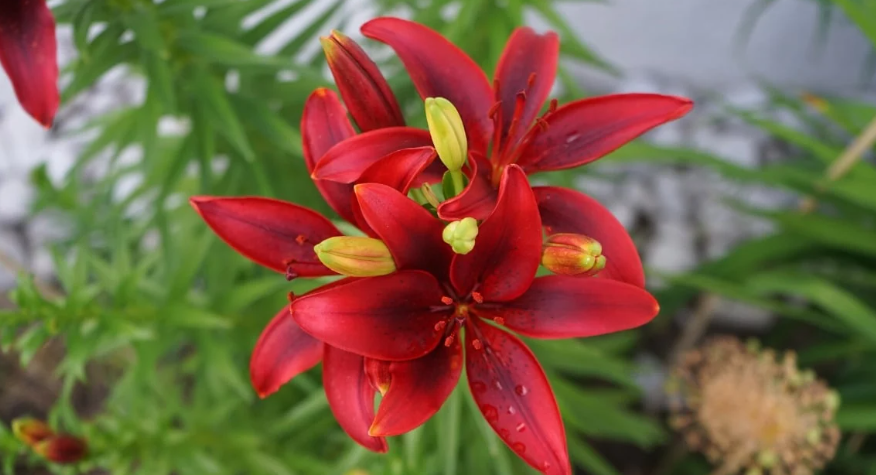
Red lilies bring a bold, dramatic energy to the garden that few other flowering bulbs can match, ranging from fiery orange-red to deep, near-black maroon tones. Most red lily types grow from bulbs planted 6 to 10 inches deep and send up a single upright stem that reaches anywhere from 18 inches to over 6 feet tall depending on the division, with individual blooms measuring 3 to 10 inches across. Red is one of the rarer natural lily colors compared to white, pink, orange, and yellow, which has made breeders particularly determined to develop deep, saturated reds through decades of hybridizing, especially within the Asiatic and Orienpet divisions.
Bloom timing for red lilies follows the same general sequence as the rest of the lily family, with Asiatic types opening first in late spring to early summer, generally staying compact at 18 to 30 inches tall, and Oriental, Orienpet, and Trumpet types following from midsummer into early fall on stems that can reach 5 to 7 feet. Fragrance varies considerably by type, with many red Asiatic hybrids bred to be entirely unscented, while red-toned Oriental and Orienpet types often carry an intense, heavy perfume capable of scenting an entire garden. A single mature stem can produce anywhere from 4 to over 20 blooms depending on the cultivar and division, with the largest Orienpet types producing the most prolific flower counts.
Red lily bulbs are notably long-lived under the right conditions, with most types persisting and multiplying in the ground for 8 to 12 years, developing small offset bulbs around the base of the mother bulb starting around the third year. Most red lily types are hardy across USDA zones 4 through 9, though some of the more heat-tolerant Orienpet hybrids can handle summer temperatures above 100 degrees Fahrenheit far better than their Oriental parents. As cut flowers, red lilies are prized for their long vase life, typically lasting 7 to 12 days in water, and their high nectar sugar content, often in the range of 22 to 26 percent sucrose, makes many red types especially attractive to hummingbirds.
Red has long carried associations with passion, desire, and boldness in floral symbolism, which has made red lilies a popular choice for romantic gestures and dramatic floral design alike. Commercial red lily bulbs are propagated almost exclusively through bulb scaling or tissue culture rather than seed, since seed-grown lilies can take 4 to 7 years to reach flowering size and rarely resemble the parent plant’s exact color. Whether planted as a bold accent in a mixed perennial border or grown in rows for cut flower production, red lilies remain one of the most eye-catching and reliably long-lasting flowering bulbs available to gardeners.
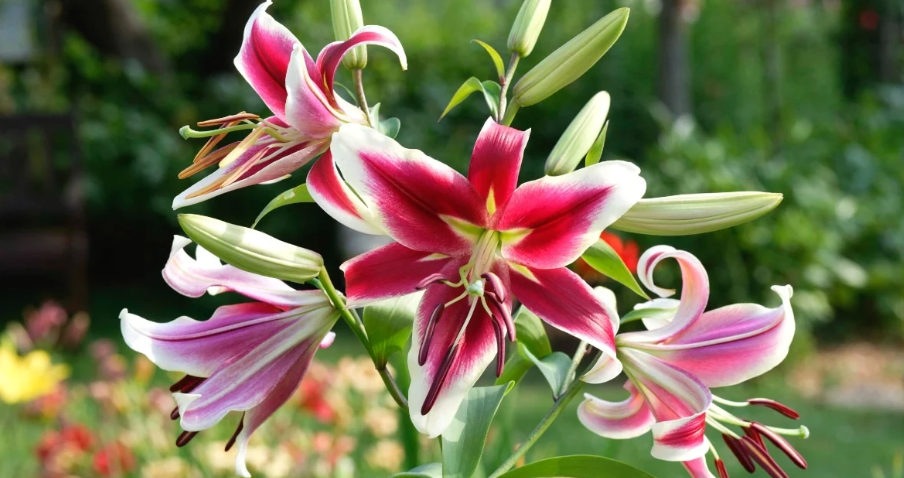
Types of Red Lilies
Scheherazade
Scheherazade is a towering Orienpet hybrid, often nicknamed a “Tree Lily” for its imposing 7-foot height, producing huge raspberry-red blooms that average 7 to 10 inches wide with a cream-to-gold throat and matching petal edging. A single mature plant can produce up to 40 down-facing flowers, each with long white stamens and brown anthers, creating an overwhelming floral display by its second or third season. This cultivar performs best in USDA zone 5 or warmer, since it does not reliably perennialize through extreme winter cold.
Silk Road
Silk Road is a giant Orienpet hybrid with creamy white exteriors and a bold crimson throat that bleeds outward into each petal, producing blooms averaging 8 to 10 inches wide on stiff, upright stems with a distinctive spiral leaf pattern. It is especially prized for its unusually long bloom time, since a second wave of bulbs typically opens just as the first round of flowers begins to fade, extending the display by several additional weeks. Silk Road has won the North American Lily Society’s popularity poll for 4 consecutive years and remains one of the most sought-after red-throated cultivars available.
Zeba
Zeba is an Oriental Trumpet hybrid that produces creamy green petals with bold red centers and speckled freckling, creating a striking two-tone effect that draws hummingbirds and butterflies into the garden. Its flowers can measure up to a foot wide on mature specimens, making it one of the largest-flowered types in the entire red lily category. Zeba prefers areas with filtered daylight rather than harsh, direct afternoon sun, which helps preserve the vividness of its coloring through the peak of summer.
Sensi
Sensi produces fragrant, ruffled pink-red blooms with rosy petals that face both upward and outward on tall, shrub-like stems, giving the plant a fuller, more architectural presence than many other red lily types. Its light, fruity fragrance is noticeable but not overpowering, making it a good choice for gardeners who want a scented lily without an overwhelming perfume. Sensi benefits from division every few years to prevent overcrowding, since its clumps expand steadily once established.
African Queen
African Queen is a Trumpet division cultivar with deep tawny-red, outward or slightly downward-facing blooms measuring 6 to 8 inches long, marked with garnet-brown shading on the outer petal surface. Stems typically reach 5 to 6 feet tall and produce clusters of 12 to 20 intensely fragrant blossoms, making it one of the most prolific bloomers in the red and orange-red lily category. This cultivar tolerates alkaline soils with a pH up to 7.4 better than most other red-toned lilies and has exceptionally rigid stems that rarely need staking.
Beverly Dream
Beverly Dream is an Orienpet hybrid with crimson-red petals accented by a band of white at the base, produced on sturdy stems that reach 4 to 5 feet tall with 8 to 12 spicy-sweet scented blooms per stem. In cold-climate field trials, this cultivar demonstrated a 92 percent survival rate over 5 consecutive winters in zone 5b conditions, making it one of the more cold-reliable red lily hybrids available. Beverly Dream requires an extended chilling period of 10 to 12 weeks with soil temperatures below 45 degrees Fahrenheit in order to properly initiate its flower buds.
Blackout
Blackout is among the darkest lilies available, with near-black maroon petals carrying a subtle crimson sheen that becomes more visible in direct sunlight. It reaches 4 to 5 feet tall with 10 to 15 blooms per stem and produces the strongest fragrance of any red-toned lily cultivar commonly grown. Blackout requires acidic soil, generally in the pH range of 5.5 to 6.2, and benefits from weekly monitoring for aphids during bud swell, since it can be more susceptible to pest pressure than lighter-colored types.
Tiny Ghost
Tiny Ghost is a dwarf Asiatic cultivar staying just 18 to 22 inches tall, producing cherry-red, strongly reflexed petals on a compact plant well suited to containers at least 12 inches wide and 14 inches deep. Its reduced chilling requirement makes it easier to overwinter in marginal climates, and it has been successfully grown in an unheated garage in zone 5 with 4 inches of mulch protection. Tiny Ghost is a favorite for patio gardeners who want bold red lily color without the height of full-sized Asiatic or Oriental types.
Red Twin
Red Twin is an award-winning Asiatic cultivar producing large, 7-inch salsa-red double blooms with an elegantly formed inner layer of narrow, reflexed petals, adding fire and drama to the early summer border. As a double-flowered type, each bloom contains significantly more petals than a standard single-form lily, giving it a fuller, rose-like appearance. Red Twin typically stays under 30 inches tall, in keeping with the generally compact growth habit of the Asiatic division.
Red Carpet
Red Carpet is a classic Asiatic cultivar valued for its bright, saturated red, upward-facing blooms and its early summer flowering, which arrives well ahead of the Oriental and Trumpet divisions. Like most Asiatic types it is unscented and stays relatively short, generally 24 to 30 inches tall, which makes it useful for the front or middle of a mixed perennial border. Because of its shorter floral tube and lower nectar yield compared to Trumpet and Orienpet types, Red Carpet tends to attract fewer hummingbirds but remains popular with native bumblebees.
Landini
Landini is one of the darkest Asiatic cultivars available, producing deep burgundy-red blooms so richly colored they can appear almost black in low light, on compact plants generally reaching 24 to 30 inches tall. Its upward-facing flowers open in early summer and hold their intense color well throughout the bloom period without fading in full sun. Landini’s dramatic, moody coloring has made it a popular choice for gardeners building high-contrast plantings alongside white or silver-foliaged companions.
Tango
Tango is a vividly colored Asiatic cultivar with bright red-orange, upward-facing blooms often marked with darker freckling near the center, produced on sturdy, compact stems reaching 24 to 28 inches tall. It flowers reliably in early summer and, like most Asiatic types, carries little to no fragrance, making it a practical choice for gardeners who prioritize color impact over scent. Tango’s high bud count per stem makes it a strong performer both in garden beds and in cutting arrangements.
Pretty Woman
Pretty Woman is an Asiatic bicolor cultivar combining bold red centers with crisp white petal edges, creating a striking two-tone bloom that stands out distinctly from solid red types. Plants typically reach 24 to 30 inches tall and flower in early to midsummer with multiple blooms per stem. Its contrasting color pattern makes Pretty Woman a popular choice for gardeners looking to add visual complexity to a red-and-white themed planting.
Grand Cru
Grand Cru is a widely grown Asiatic cultivar featuring deep red petals that fade to a bright yellow base, creating a bold sunburst effect at the center of each bloom. It reaches 24 to 32 inches tall and produces multiple upward-facing flowers per stem in early summer, with a high bud count typical of the Asiatic division. Grand Cru’s striking bicolor pattern has made it one of the most recognizable and commercially popular red-toned Asiatic lilies in cultivation.
Matrix
Matrix is a compact Asiatic cultivar with rich, velvety red blooms and a tidy, uniform growth habit, typically staying between 20 and 26 inches tall. It flowers early in the season, generally ahead of most Oriental and Trumpet types, and its unscented, upward-facing blooms make it a dependable choice for mixed containers and border plantings. Matrix is valued by commercial growers for its consistency and reliable bud count from one growing season to the next.
Monte Negro
Monte Negro produces some of the deepest, most saturated red blooms in the Asiatic division, with a velvety texture that intensifies its dark coloring under bright sunlight. Plants typically reach 24 to 30 inches tall and flower in early summer with multiple blooms held on sturdy, upright stems. Monte Negro’s name, referencing its near-black red tone, reflects its popularity among gardeners seeking the darkest possible red in a lily bloom.
Red Velvet
Red Velvet is an Asiatic cultivar with plush, deep red petals and a slightly glossy sheen that gives the bloom a rich, textured appearance reminiscent of its namesake fabric. It stays compact at 22 to 28 inches tall, flowers in early summer, and produces little to no fragrance, consistent with most other members of the Asiatic division. Red Velvet’s dependable performance and vivid color have made it a long-standing favorite among home gardeners.
Corina
Corina is a dark red Asiatic cultivar known for its exceptionally uniform bloom color and reliable early summer flowering, typically reaching 24 to 30 inches in height. Its upward-facing blooms hold their deep coloring from bud to full bloom without significant fading, a trait that distinguishes it from some other red types that lighten as the flower ages. Corina is a popular choice for commercial cut flower production because of this color consistency.
Fangio
Fangio produces bold, fiery red blooms on sturdy, compact Asiatic-type stems, generally reaching 24 to 28 inches tall with multiple flowers per stem in early summer. Its intense coloring and reliable bud count make it a strong performer in both garden beds and cutting gardens. Like most Asiatic hybrids, Fangio is unscented and requires minimal maintenance once established.
Netty’s Pride
Netty’s Pride is a deep red Asiatic cultivar valued for its rich, uniform color and vigorous, disease-resistant growth habit, typically reaching 24 to 30 inches tall. It flowers in early summer with an above-average bud count for its division, often producing 6 or more blooms per stem under good growing conditions. Netty’s Pride has remained popular with home gardeners for its combination of bold color and low-maintenance reliability.
Montreux
Montreux is a red-toned Orienpet hybrid combining the heat tolerance and vigor of Trumpet lilies with the fragrance and flower size of Oriental types. It typically reaches 4 to 5 feet tall with large, richly colored blooms that hold up well in humid or high-temperature conditions that can challenge pure Oriental cultivars. Montreux is often recommended for Mid-Atlantic, Midwest, and Upper South gardens where summer heat and humidity are significant growing factors.
Robina
Robina is a red Asiatic cultivar with bright, saturated blooms and a compact, well-branched growth habit, typically staying between 24 and 30 inches tall. It flowers early in the season and produces a high bud count relative to its size, making it a productive choice for both ornamental beds and cut flower use. Robina shares the Asiatic division’s typical lack of fragrance and its preference for full sun.
Fireball
Fireball lives up to its name with intensely bright, orange-red blooms that seem to glow against its dark green foliage, produced on sturdy Asiatic-type stems reaching 24 to 30 inches tall. It flowers in early summer with multiple upward-facing blooms per stem and is especially popular for adding a hot, energetic splash of color to early-season borders. Fireball is unscented but compensates with an exceptionally vivid, saturated hue.
Red Alert
Red Alert is a bright, true-red Asiatic cultivar bred for bold color impact, typically reaching 24 to 28 inches tall with a dense cluster of upward-facing blooms per stem. It flowers reliably in early summer and, like most Asiatic types, requires minimal care beyond adequate sun and well-draining soil. Red Alert’s compact size and vivid color have made it a popular choice for mass plantings where a strong block of red is desired.
Claude Shride
Claude Shride is a striking Martagon, or Turk’s Cap, hybrid with deep, dark red, strongly recurved petals held on tall, willowy stems that can reach 4 to 5 feet in the right conditions. Unlike Asiatic and Oriental types, Martagon lilies prefer light, dappled shade and can take 2 to 3 years to fully establish before reaching their best flowering performance. Once settled, Claude Shride produces multiple down-facing, richly colored blooms per stem and is considered one of the more reliably vigorous cultivars within its division.
Scarlet Turk’s Cap Lily
Scarlet Turk’s Cap Lily is a species type with small, brilliant scarlet-red blooms and dramatically recurved petals, giving each flower a distinctive swept-back, cap-like shape. It typically grows 2 to 4 feet tall and produces multiple down-facing blooms per stem in early to midsummer, thriving in full sun to light shade. This species has been cultivated in European gardens since at least the late 16th century, making it one of the longest-documented red-flowered lily types in cultivation.
Splendens Tiger Lily
Splendens Tiger Lily is a deeply colored form of the classic Tiger Lily, producing strongly recurved, deep orange-red petals covered in dark speckling on stems that can reach 4 to 5 feet tall. Shiny black bulblets form along the stem and can be collected to propagate new plants, a trait shared with other members of the Tiger Lily group. It is among the hardiest red-toned lily types available, tolerating USDA zones as cold as zone 3, and flowers in late summer with an old-fashioned, naturalized charm.
Wood Lily
Wood Lily is a native North American species with upward-facing, cup-shaped blooms in shades of orange-red to deep red, generally accented with dark spotting near the throat. It stays relatively short, typically 1 to 2 feet tall, and is best suited to naturalized meadow or woodland-edge plantings rather than formal beds. Wood Lily is less commonly available commercially than hybridized red lily types and is often sourced through specialty native plant nurseries.
Cancun
Cancun is a vividly colored Asiatic cultivar with bright red-orange blooms and a compact, uniform growth habit, typically reaching 24 to 28 inches tall with several flowers per stem. It flowers in early summer and, like most Asiatic hybrids, carries little fragrance, making it a practical addition to gardens where a bold pop of warm color is the primary goal. Cancun’s dependable performance and vivid tone have made it a popular choice among commercial lily growers.