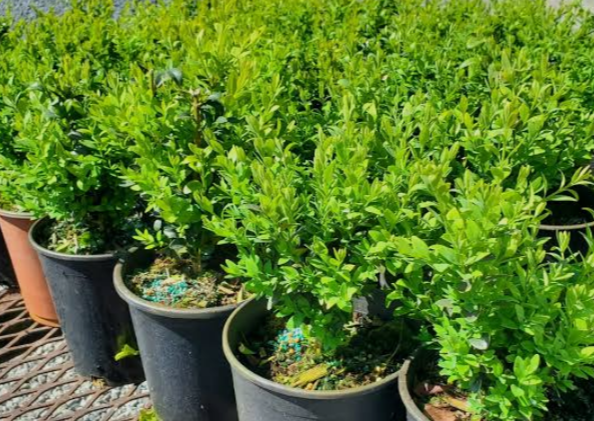
Justin Brouwers boxwood is a compact, rounded evergreen that looks much like English boxwood but grows a little faster and handles cold better. Its dense mound of small, dark green leaves makes a neat, low hedge or edging plant with very little effort. For many years, it was one of the most popular choices for gardeners who wanted the classic English boxwood look in a hardier package.
Its rich color and tidy shape still make it attractive in the landscape. However, it is highly susceptible to boxwood blight and boxwood leafminer, two of the most serious threats to boxwoods today. Gardeners who choose it need to plant it carefully and watch closely for problems.
Botanical Classification
Justin Brouwers belongs to the box family, a small group of evergreen shrubs that also includes pachysandra and sweet box. It is usually listed as a form of common boxwood, though some references place it with Korean boxwood. This mix of names reflects its blend of traits, with the fine look of European boxwood and better cold tolerance than English boxwood.
It is named after the nurseryman who selected it. Like many boxwood cultivars, it is propagated from cuttings, so every plant sold under this name shares the same compact habit and dark green color.
Brief History
English boxwood has been the classic edging plant of formal gardens for centuries, but it grows extremely slowly and struggles in colder climates. In the late 20th century, gardeners and nurseries looked for alternatives that offered the same soft, mounded look with faster growth and better hardiness.
Justin Brouwers filled that role well. It became especially popular in the late 1900s and early 2000s, when it was widely planted as a substitute for English boxwood in hedges and foundation beds. Its popularity declined somewhat after boxwood blight arrived in the United States in 2011, since it proved highly vulnerable to the disease.
Identifying Characteristics
Justin Brouwers has small, oval leaves about half an inch long. They are dark green, slightly glossy and densely packed along short stems. The leaves grow in pairs on opposite sides of the stem, giving the plant a fine, velvety texture similar to English boxwood. It holds its dark green color well in winter.
It grows into a compact, rounded mound about 2 to 3 feet tall and wide. It grows slowly, often only a few inches a year, though faster than English boxwood. In early spring, it produces tiny, fragrant, pale yellow-green flowers that attract bees but are easy to overlook. Like other common boxwoods, its leaves have a musky scent.
Landscape Uses
Justin Brouwers is well suited to low hedges and edging. Its naturally rounded shape creates a neat border along walkways, driveways, patios and flower beds. It is a good fit for formal gardens, knot gardens and parterres, where its fine texture helps create crisp lines.
It also works well in foundation plantings, where its compact size fits under windows and along the front of houses. Single plants make attractive accents near steps and entrances, and it grows well in containers. Like other boxwoods, it is deer-resistant, and all parts of the plant are toxic if eaten.
Growing Considerations
Justin Brouwers is generally hardy from about USDA zone 5 to zone 8. It grows well in the Mid-Atlantic, Northeast, Midwest and Pacific Northwest. It tolerates colder winters than English boxwood, which makes it useful in areas where English boxwood struggles.
It grows in full sun to partial shade. In hot regions, afternoon shade helps prevent leaf scorch. In colder areas, a spot sheltered from strong winter wind helps keep its leaves green and healthy.
Good drainage is essential. Like all boxwoods, it can develop root rot in waterlogged soil. It grows best in loose, well-drained soil enriched with compost, with a slightly acidic to neutral pH of about 6.5 to 7.0. A thin layer of mulch, about 1 to 2 inches, helps protect its shallow roots, but mulch should not touch the stems. Water young plants regularly and established plants deeply during dry spells.
Pruning and Care
Justin Brouwers needs only light pruning because of its slow growth and naturally rounded form. Trim it in late spring after new growth hardens. Formal hedges may need a second light trim in early summer.
Avoid pruning in late summer or fall, which can trigger tender growth that is damaged by frost. Thinning a few interior branches each year lets in light and air, which is especially important for this disease-prone boxwood. Clearing fallen leaves and debris from inside and around the plant also helps reduce disease.
Pests and Diseases
Justin Brouwers is highly susceptible to boxwood blight. This fungal disease, first found in the United States in 2011, causes dark leaf spots, black streaks on stems and rapid leaf drop. It spreads in warm, humid weather and on infected plants, tools and clothing. In areas where blight is common, this boxwood may decline quickly once infected.
To reduce the risk, buy plants from reputable nurseries, space them for good airflow and water at the base of the plant rather than over the leaves. Avoid working among wet plants, and clean pruning tools between plants. Removing infected branches and fallen leaves promptly also helps slow the spread.
It is also very susceptible to boxwood leafminer, a tiny fly whose larvae tunnel inside leaves and cause yellow or brown blisters. Other possible problems include spider mites, boxwood psyllids and root rot in wet soils. The invasive box tree moth, whose caterpillars can strip boxwoods of their leaves, has spread across Europe and into parts of North America and should be watched for in late spring and summer.
Justin Brouwers vs. Other Boxwoods
Justin Brouwers is often compared with English boxwood. Both have a soft, rounded form and fine texture, but Justin Brouwers grows faster and handles colder winters. Both are highly susceptible to boxwood blight.
For gardeners who want a similar look with better disease resistance, several alternatives are available. North Star forms a compact globe and has shown good resistance to blight. NewGen Independence has glossy, dark green leaves and strong resistance to both blight and leafminer. Korean boxwood cultivars such as Nana also offer good blight resistance in a low, compact form.
Frequently Asked Questions
How big does Justin Brouwers boxwood get? It usually grows about 2 to 3 feet tall and wide. It reaches this size slowly over several years. Its compact size makes it a good choice for low hedges and edging.
Is Justin Brouwers boxwood a good substitute for English boxwood? It offers a very similar look with faster growth and better cold hardiness. However, like English boxwood, it is highly susceptible to boxwood blight. In blight-prone areas, more resistant boxwoods may be a better choice.
Is Justin Brouwers boxwood resistant to boxwood blight? No, it is highly susceptible to boxwood blight. Good airflow, careful watering and buying from reputable nurseries help reduce the risk. Removing fallen leaves and infected branches promptly also helps.
How far apart should Justin Brouwers boxwoods be planted for a hedge? For a low hedge, plants are usually spaced about 18 inches to 2 feet apart. Closer spacing fills in faster but reduces airflow. Allowing some space between plants helps lower the risk of disease.
Sources
Virginia Tech, “Boxwood Blight Resistant and Susceptible Cultivars”