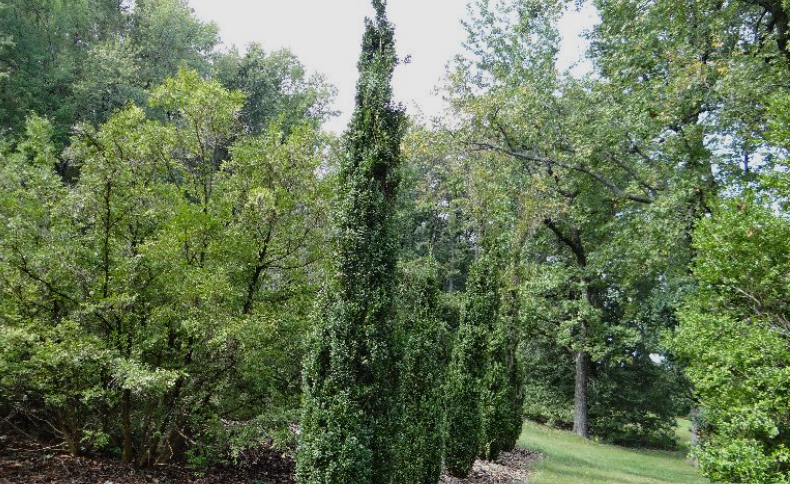
Graham Blandy boxwood is one of the narrowest upright boxwoods available. It grows into a tall, slim column of dark green leaves, often reaching well over head height while staying only a foot or two wide. That striking vertical form has made it a favorite for formal gardens, tight spaces and dramatic accents.
Garden designers often describe it as a living exclamation point. A single plant draws the eye, while a row of them creates a crisp, architectural screen. It does need some extra care, especially in snowy regions and areas affected by boxwood blight, but in the right spot it adds structure few other evergreens can match.
Botanical Classification
Graham Blandy belongs to the box family, a small group of evergreen shrubs that also includes pachysandra and sweet box. It is a cultivar of common boxwood, the species native to southern and western Europe, North Africa and western Asia.
It is one of several upright forms of common boxwood, along with Dee Runk and Fastigiata. Among these, Graham Blandy is the narrowest, with branches that grow tightly upward from the base.
Brief History
Graham Blandy boxwood was selected in Virginia and named in honor of Graham Blandy, a New York businessman whose Virginia estate later became a well-known research farm and arboretum. The plant was chosen for its unusually narrow, columnar habit.
Virginia has a long tradition of boxwood gardens dating back to colonial times, and upright boxwoods were valued for adding height and structure to formal designs. Graham Blandy became popular in the 20th century as gardeners looked for tall boxwoods that could fit into narrow spaces. It remains one of the best-known columnar boxwoods in North America.
Identifying Characteristics
Graham Blandy has small, oval leaves about half an inch to an inch long. They are dark green, glossy and slightly leathery. The leaves grow in pairs on opposite sides of the stem and are packed closely along the upright branches.
Its defining feature is its extremely narrow, columnar form. Over many years, it can reach 8 to 15 feet tall while staying only about 1 to 2 feet wide. Its branches grow straight up and close together, giving it a dense, pillar-like look.
It grows slowly, often only a few inches a year. Like other common boxwoods, its leaves have a musky scent, especially in warm weather. In early spring, it produces tiny, fragrant, pale yellow-green flowers that attract bees but are easy to miss.
Landscape Uses
Graham Blandy is ideal for vertical accents in small or formal spaces. A pair planted on each side of a doorway, gate or garden opening creates a dramatic, symmetrical frame. Single plants work well as focal points at the ends of paths or in the corners of beds.
Planted in a row, it forms a tall, narrow screen that takes up very little ground space. This makes it useful along walls, fences, narrow side yards and between houses. It can also be used to add rhythm along a walkway or to frame views.
It grows well in large, deep containers, where it adds height to patios and entryways. Like other boxwoods, it is deer-resistant. All parts of the plant are toxic if eaten, so it should be kept away from pets and livestock.
Growing Considerations
Graham Blandy is generally hardy from about USDA zone 5 to zone 8. It grows best in regions with moderate summers and winters, such as the Mid-Atlantic, Northeast and Pacific Northwest.
It grows in full sun to partial shade. In hot regions, afternoon shade helps prevent leaf scorch. In colder areas, protection from strong winter wind helps prevent winter burn and keeps the leaves green.
Good drainage is essential. Like all boxwoods, Graham Blandy can develop root rot in soggy soil. It grows best in loose, well-drained soil enriched with compost, with a slightly acidic to neutral pH of about 6.5 to 7.0.
Its roots are shallow, so a thin layer of mulch, about 1 to 2 inches, helps keep them cool and moist. Keep mulch away from the stems. Water young plants regularly, and give established plants a deep watering in fall before the ground freezes.
Pruning and Care
Graham Blandy rarely needs pruning because it naturally keeps its narrow shape. A light trim in late spring, after new growth hardens, can tidy any stray shoots. Avoid cutting into the center of the plant, which can create gaps that are slow to fill.
Snow and ice are its biggest care challenge. Heavy snow can bend its tall stems outward or split the column. In snowy areas, gardeners often wrap the plant loosely with soft twine or netting in late fall to keep the branches together. Gently brushing off snow after storms also helps.
Thinning a few interior branches lets in light and air, which helps reduce disease. Light fertilizer in spring can help if growth is weak or leaves look pale.
Pests and Diseases
Graham Blandy is highly susceptible to boxwood blight, a fungal disease first found in the United States in 2011. In trials, it showed some of the heaviest leaf loss of any boxwood tested. Blight causes dark leaf spots, black streaks on stems and rapid leaf drop, and it spreads in warm, humid weather.
To reduce the risk, buy plants from reputable nurseries, space them for good airflow and water at the base of the plant rather than over the leaves. Avoid working among plants when the foliage is wet, and clean tools between plants. In areas where blight is common, more resistant upright boxwoods may be a better choice.
Other possible problems include the boxwood leafminer, boxwood psyllids, spider mites and root rot in poorly drained soils. The invasive box tree moth, whose caterpillars can strip boxwoods of their leaves, has spread across Europe and into parts of North America and should be watched for in late spring and summer.
Graham Blandy vs. Other Upright Boxwoods
Graham Blandy is narrower than any other common upright boxwood. Dee Runk grows into a column about 8 feet tall and 2 to 3 feet wide, and it is rated moderately resistant to boxwood blight. Fastigiata grows 10 to 12 feet tall and 3 to 4 feet wide, also with moderate blight resistance.
Green Mountain, a hybrid boxwood, forms a broader cone about 5 feet tall and is more cold-hardy. For the narrowest possible boxwood column, Graham Blandy is unmatched, but Dee Runk and Fastigiata offer better disease resistance where blight is a concern.
Frequently Asked Questions
How tall does Graham Blandy boxwood get? It can reach about 8 to 15 feet tall over many years. It grows slowly, so it takes a long time to reach full height. Light trimming can keep it shorter if needed.
How wide does Graham Blandy boxwood get? It usually stays only about 1 to 2 feet wide. This makes it one of the narrowest boxwoods available. Its slim form fits easily into tight spaces.
Is Graham Blandy boxwood resistant to boxwood blight? No, it is highly susceptible to boxwood blight. Good airflow, careful watering and buying from reputable nurseries help reduce the risk. In blight-prone areas, Dee Runk or Fastigiata may be better choices.
How do you keep Graham Blandy boxwood from splaying in snow? Loosely wrapping the plant with soft twine or netting in late fall keeps the branches together. Gently brushing heavy snow off after storms also helps. Avoid shaking frozen branches, which can cause them to break.
How far apart should Graham Blandy boxwoods be planted for a screen? For a continuous screen, plants are usually spaced about 1.5 to 2 feet apart. Slightly wider spacing improves airflow and lowers disease risk. Spacing depends on how quickly a solid screen is needed.
Can Graham Blandy boxwood grow in containers? Yes, it grows well in large, deep containers and makes a striking vertical accent. Containers need good drainage and regular watering. In cold climates, potted plants should be protected from harsh winter weather.
Sources