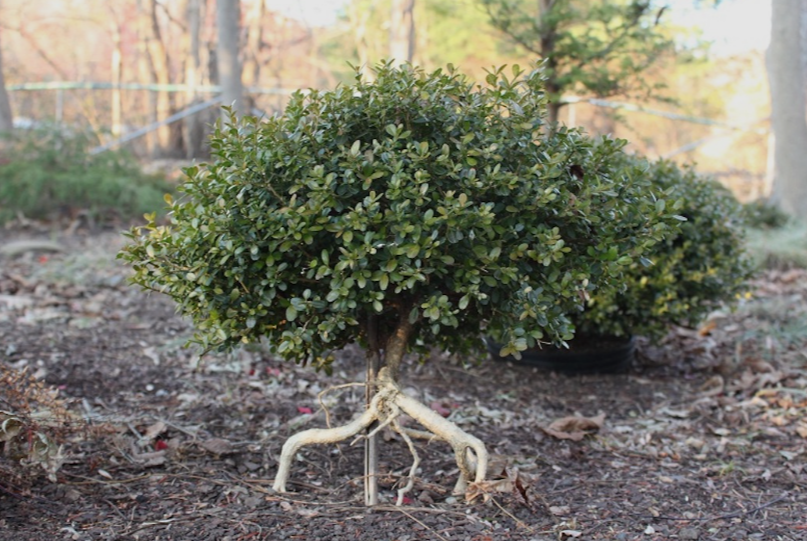
Morris Midget is one of the smallest boxwoods available. This tiny evergreen forms a tight, rounded cushion of bright green leaves that stays only about a foot tall for many years. It is a favorite for miniature gardens, rock gardens, troughs and small-scale edging, where larger boxwoods would quickly outgrow their space.
Its slow growth and neat shape mean it needs very little pruning. For gardeners who love the look of boxwood but have limited room, Morris Midget offers the same fine texture and evergreen structure in a much smaller package.
Botanical Classification
Morris Midget belongs to the box family, a small group of evergreen shrubs that also includes pachysandra and sweet box. It is a dwarf cultivar of Japanese boxwood, which is itself a variety of littleleaf boxwood. These small-leaved Asian boxwoods are known for their bright foliage and good heat tolerance.
It is closely related to another dwarf selection called Morris Dwarf. Both share a compact, mounding habit, but Morris Midget is generally the smaller and tighter of the two.
Brief History
Morris Midget was selected in the United States and named for the Morris Arboretum in Philadelphia, where it was found. Arboretums and nurseries in the mid-1900s were searching for small boxwoods that could be used in tight spaces, rock gardens and miniature landscapes.
It quickly gained a following among collectors of dwarf plants and bonsai growers. Today, it is widely available in specialty nurseries and garden centers, especially in the eastern United States.
Identifying Characteristics
Morris Midget has very small, oval leaves, usually less than half an inch long. They are bright to yellow-green and slightly glossy. The leaves grow in pairs on opposite sides of the stem and are tightly packed together.
It forms a low, dense, rounded mound. Most plants stay about 1 foot tall and 1 to 1.5 feet wide after many years. It grows extremely slowly, often only about an inch a year.
In cold winters, its leaves may turn bronze or yellowish, especially in exposed sites. This color usually fades back to green in spring. Like other boxwoods, it produces tiny, pale yellow-green flowers in early spring, though they are easy to miss on such a small plant.
Landscape Uses
Morris Midget is ideal for miniature and small-scale gardens. It suits rock gardens, alpine troughs, fairy gardens and model railway landscapes, where its tiny leaves and compact form stay in proportion to the setting.
It also makes a charming low edging plant. Planted in a row, it forms a tiny hedge along paths, herb beds and small knot gardens. Because it grows so slowly, it holds its shape for years with little work.
It is a popular choice for bonsai, since its small leaves and dense growth suit miniature trees. It also grows well in containers and window boxes. Like other boxwoods, it is deer-resistant, and all parts of the plant are toxic if eaten.
Growing Considerations
Morris Midget is generally hardy from about USDA zone 6 to zone 8, and it can grow in zone 9 with some afternoon shade. It does well in the Mid-Atlantic, Southeast and many parts of the Midwest and Pacific Northwest.
It grows in full sun to partial shade. In hot climates, afternoon shade helps prevent leaf scorch. In colder areas, protection from winter wind and sun helps reduce bronzing.
Good drainage is essential. Its small, shallow roots can rot quickly in soggy soil. It grows best in loose, well-drained soil enriched with compost, and it does especially well in rock gardens and raised beds.
A light layer of fine mulch or gravel helps keep its roots cool and moist. Keep mulch away from the stems. Water young plants regularly, and check container plants often, since small pots dry out quickly.
Pruning and Care
Morris Midget needs very little pruning. Its natural shape is tight and rounded, so an occasional light trim in late spring is usually enough. Remove any stray shoots to keep a tidy outline.
Avoid heavy pruning, since it grows so slowly that mistakes take a long time to grow back. Gently clearing fallen leaves and debris from around and inside the plant helps reduce disease.
Fertilize lightly in spring if growth is weak or leaves look pale. Container plants need more regular feeding and watering. In colder areas, potted plants should be moved to a sheltered spot for winter.
Pests and Diseases
Morris Midget is generally easy to grow, but it is not among the most disease-resistant boxwoods. It can be affected by boxwood blight, a fungal disease first found in the United States in 2011 that causes leaf spots, black stem streaks and rapid leaf drop. Good air circulation and avoiding overhead watering help reduce the risk.
Other possible problems include boxwood leafminer, spider mites and root rot in poorly drained soils. Spider mites can be more common on plants grown in hot, dry spots or indoors.
The invasive box tree moth, whose caterpillars can strip boxwoods of their leaves, has spread across Europe and into parts of North America. Even small plants should be checked for webbing and chewed leaves in late spring and summer.
Morris Midget vs. Other Dwarf Boxwoods
Morris Midget is often compared with other dwarf boxwoods. Morris Dwarf is slightly larger and looser, while Morris Midget forms a tighter, smaller mound. Grace Hendrick Phillips is another very low cushion boxwood, with fine leaves and a flat, spreading habit.
Kingsville Dwarf is a famous miniature boxwood prized by bonsai growers for its tiny leaves and very slow growth. For gardeners who want a small, rounded boxwood that is easy to find and simple to grow, Morris Midget is one of the most popular choices.
Sources
Virginia Tech, “Boxwood (Buxus species)”
Virginia Tech, “Boxwood Blight Resistant and Susceptible Cultivars”
North Carolina State University, “Susceptibility of Commercial Boxwood Cultivars to Boxwood Blight”