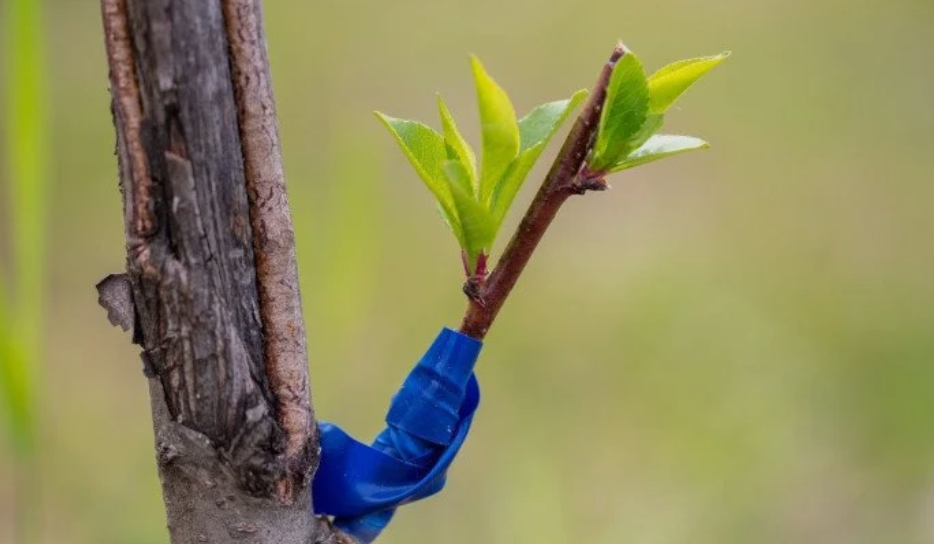
Grafting is a plant propagation technique in which tissues from two different plants are joined together so they grow as a single plant. The upper part, known as the scion, is selected for its desirable qualities such as good fruit, flowers, or growth habit, while the lower part, called the rootstock, provides the root system and influences traits like disease resistance, size control, and environmental tolerance. When properly joined, the tissues heal and form a living connection that allows water and nutrients to move between the two parts.
At the heart of grafting is the successful union of the cambium layers, the thin growing tissues located just beneath the bark. For grafting to work, these layers must be placed in close contact so new cells can grow across the join and fuse the plants together. Once healing occurs, the scion continues growing as if it were naturally part of the rootstock, producing leaves, flowers, or fruits according to its genetic characteristics.
Grafting has been practiced for thousands of years and is especially important in agriculture and horticulture. Many fruit trees grown today cannot be reliably produced from seed because seedlings may not retain the parent plant’s qualities. Through grafting, growers can reproduce exact copies of superior varieties while benefiting from strong or adaptable root systems. This ensures consistency in orchards and improves crop productivity.
There are many grafting methods, ranging from techniques that use entire shoots to those that use only a single bud, such as bud grafting (budding). Different techniques are chosen depending on plant species, stem size, season, and purpose. Some methods are designed for young plants, while others help repair damaged trees or change the variety growing on an established plant without removing its root system.
Grafting offers several advantages beyond simple propagation. It can increase resistance to pests and diseases, improve tolerance to drought or poor soils, control plant size, and even speed up fruit production compared to seed-grown plants. Gardeners and farmers also use grafting to combine traits that would be difficult or impossible to achieve through traditional breeding alone.
Whip and Tongue Grafting
Whip and tongue grafting is commonly used when the rootstock and scion are about the same thickness. Both parts are cut diagonally, and an additional slit (the “tongue”) is made in each piece so they interlock securely. This creates a large contact area between the cambium layers, allowing strong healing and rapid growth. It is widely used for fruit trees such as apples and pears because it produces a neat and durable union.
Cleft Grafting
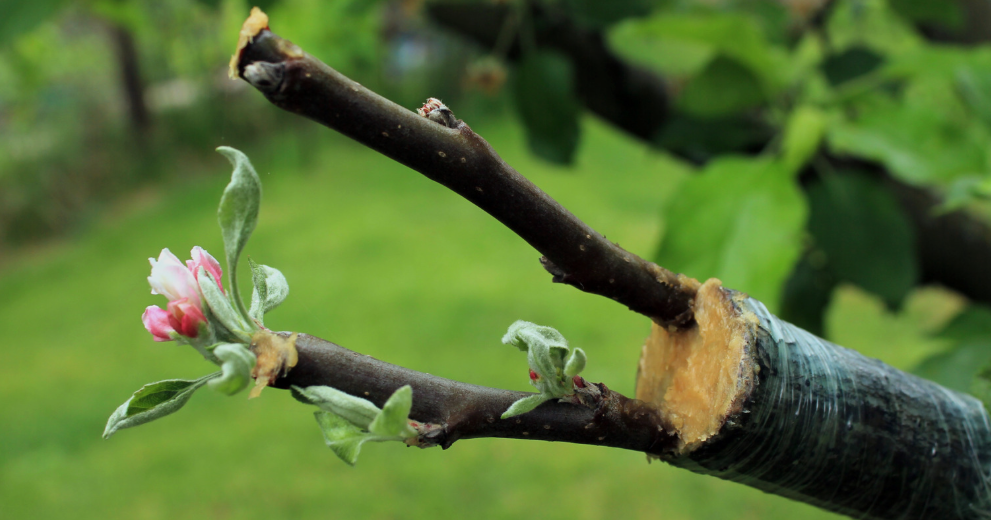
Cleft grafting is typically used to change varieties on established trees. The rootstock branch or trunk is cut off and split down the center, forming a cleft into which one or two scions are inserted. The method works well when the rootstock is thicker than the scion. It is often performed in early spring and is popular for rejuvenating old orchards.
Bark Grafting
Bark grafting is suitable for large rootstocks when the bark easily separates from the wood during active growth. The bark is carefully lifted, and the scion is inserted between the bark and wood. This method is useful for top-working mature trees and allows multiple scions to be attached around a large trunk or branch.
Side Veneer Grafting
Side veneer grafting involves inserting a scion into a shallow cut made on the side of the rootstock without removing the top immediately. After the graft heals, the upper part of the rootstock is pruned away to encourage scion growth. This technique is commonly used for ornamental plants and conifers because it causes minimal stress to the plant.
Approach Grafting (Inarching)
In approach grafting, both the scion and rootstock remain rooted in the soil during the grafting process. A section of bark and wood is removed from each plant, and the exposed areas are joined together until they fuse. Once the union is strong, the scion is separated from its original root system. This method is useful for difficult-to-graft species.
Bud Grafting (Budding)
Bud grafting uses a single bud rather than an entire shoot as the scion. A bud is removed from one plant and inserted under the bark of the rootstock. The technique is efficient because many grafts can be made from one plant. It is widely used in commercial nurseries, especially for roses and citrus trees.
T-Budding
T-budding is a specific type of budding where a T-shaped cut is made in the bark of the rootstock. A bud shield is slipped under the bark flaps and secured tightly. This method works best when the bark “slips,” meaning it separates easily from the wood. It is commonly used for fruit trees and ornamental plants.
Saddle Grafting
Saddle grafting involves shaping the scion into a saddle-like notch that fits over the cut top of the rootstock. The two pieces align closely, increasing cambium contact and stability. This technique is often used when both scion and rootstock are of equal diameter and is favored for small woody plants.
Bridge Grafting
Bridge grafting is mainly used to repair damaged trees, especially when bark has been stripped by animals or injury. Several scions are inserted above and below the damaged area, forming a “bridge” that reconnects nutrient flow between roots and canopy. This method can save trees that would otherwise die.
Splice Grafting
Splice grafting is one of the simplest techniques and involves making matching diagonal cuts on both scion and rootstock, then binding them together. It works best when both parts are the same size. Although easy to perform, it requires careful securing because it lacks the interlocking structure found in whip and tongue grafting.
Crown Grafting
Crown grafting is used to replace the top portion of a tree with a new variety. Several scions are inserted around the outer edge of a cut trunk or large branch, just beneath the bark. Over time, the scions grow to form a new canopy. This technique is often applied to mature fruit trees to improve productivity or change cultivars.