Purple flowering trees create an enchanting and peaceful atmosphere in the surroundings. Some produce edible fruits whereas others provide shade and attract birds and bees to the garden. When it to comes to trees with purple flowers, most of them are usually small to medium in size.
Most of the purple flowering trees are native to Europe and Asia with a few species native to North America. Generally, these tree are very particularly beautiful during spring and other for ornamental purposes, these tree still can be grown for other different purposes in the landscape.
In this article, I will look at some of the most popular purple flowering trees and their unique features, growth habits, and cultural requirements. I will also elaborate the ways in which these trees can be incorporated into different landscaping styles to create stunning outdoor spaces.
List of Trees With Purple Flowers
- Jacaranda (Jacaranda mimosifolia)
- Crape Myrtle (Lagerstroemia indica)
- Chaste Tree (Vitex agnus-castus)
- Eastern Redbud Tree (Cercis canadensis)
- Desert Willow (Chilopsis linearis)
- Lilac Bush (Syringa vulgaris)
- Wisteria (Wisteria)
- Hong Kong orchid tree (Bauhinia x blakeana)
- Purple Glory Tree (Tibouchina granulosa)
- Purple Robe Locust Tree (Robinia pseudoacacia “Purple Robe”)
- Texas Mountain Laurel (Sophora secundiflora)
- Royalty Crabapple (Malus angustifolia)
- Royal Empress Tree (Paulownia tomentosa)
- Takasago Flowering Cherry (Prunus × sieboldii ‘Caespitosa’)
- Royal Purple Smoke tree (Cotinus coggygria “Royal Purple”)
- Cork Bush Tree (Mundulea sericea)
- Malabar Rosewood (Dalbergia latifolia)
- Purple Orchid Tree (Bauhinia purpurea)
- Tibouchina (Tibouchina urvilleana)
- Purple-Leaf Ornamental Plum (Prunus cerasifera ‘Nigra’)
- Purple Trumpet Tree (Tabebuia impetiginosa)
Purple Flowering Trees
Jacaranda Tree
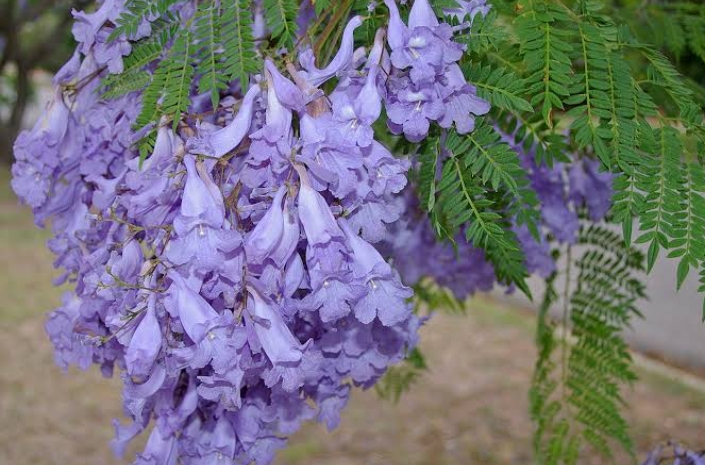
Jacaranda is a fast-growing deciduous tree native of warm regions of South America and the United States but widely grown as ornamental trees in subtropical and tropical regions worldwide. Mature jacaranda trees can reach heights of between 15 and 40 feet, and their horizontal spread may be even wider, making them impressive garden specimens that need plenty of room to grow.
Jacaranda feature trumpet-shaped flowers that bloom in a profusion of violet-blue or lilac-blue. The flowers appear in large clusters and cover the entire tree particularly in the spring and are produced in abundance. The flowers are produced on the tips of branches and appear before the leaves. The blooms will last for several weeks, depending on the climate and weather conditions.
In warm, humid climates, the tree can flower annually, providing a stunning display of color and beauty each year. In cooler climates, the tree may flower less frequently.
Crape Myrtle
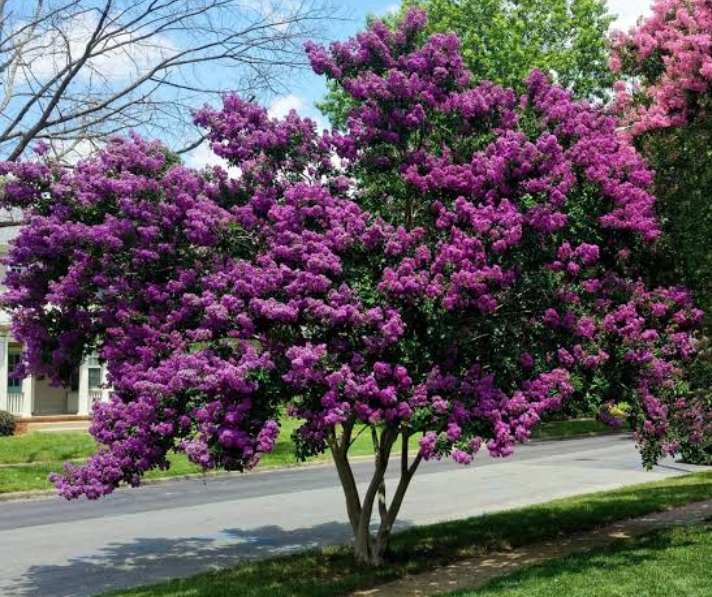
The Crape Myrtle is a deciduous or evergreen tree or shrub native to the Indian subcontinent and Southeast Asia. It is common in many places as an ornamental plant for its handsome bark, sinewy branches and long-lasting spectacular flowers. Crape Myrtles are popular in warm climates, including the Southern United States, where they are often grown as street trees, in parks and in residential gardens.
Some species can reach heights of up to 40 feet, while others only grow to be a few feet tall. Dwarf cultivars can be as small as 2-3 feet. Its deciduous foliage turns orange and red in autumn. This is actually an all-season’s tree growing in USDA plant hardiness zones 6 to 9. The most common Crape Myrtles have pink or red flowers, there are many varieties too with that bear purple flowers.
The flowers of crape myrtle are large, petal-rich clusters. The shape of crape myrtle flowers can vary, but most have a crinkled or crepe-like texture that gives the plant its common name. The petals are often ruffled and delicate, with a delicate fragrance that is especially noticeable on warm, sunny days. They usually bloom in the summer and can last for several weeks.
Chaste Tree
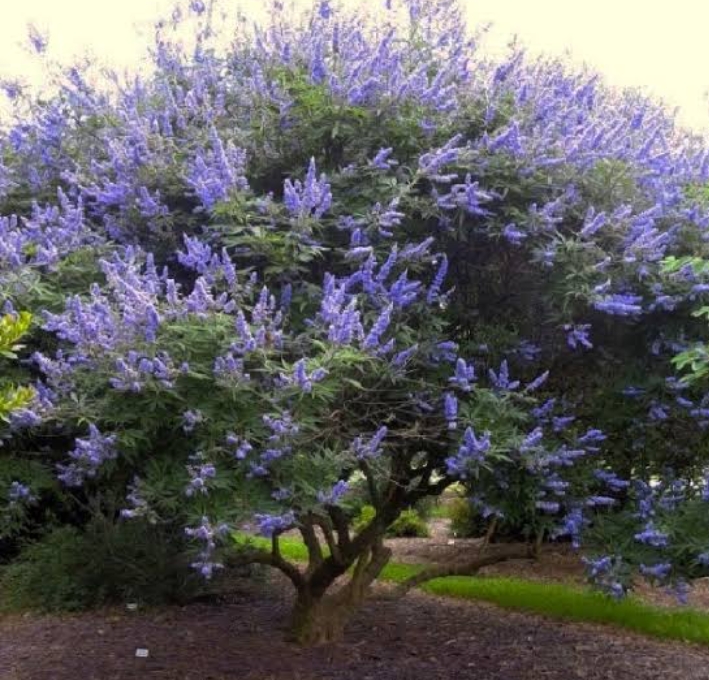
The Chaste Tree, also known as chasteberry, Abraham’s balm grows as a broadly spreading large shrub to small tree, reaching 15 to 25 feet tall with aromatic leaves. It is native to the Mediterranean and Central Asia. Its pliable twigs are used in basketry. Its fruits are used for flavoring and in herbal medicine.
Under optimal conditions, the plant can withstand temperatures as low as -23°C (-9°F) and is hardy in USDA Zone 6. It is common in various regions including the south shore of Long Island and Nantucket on the East Coast of North America, and in the temperate southwest of England.
The flowers of the Chaste Tree are one of its defining features and a major reason why this tree can just be fine when grown as an ornamental tree. They are produced in spikes or racemes and come in various shades of purple or lavender. Each flower has five petals and is distinctive in shape, with a long central stalk and an umbrella-like structure. The flowers of the Chaste Tree are highly fragrant with a long bloom period, beginning from late spring and lasting to early summer.
Eastern Redbud
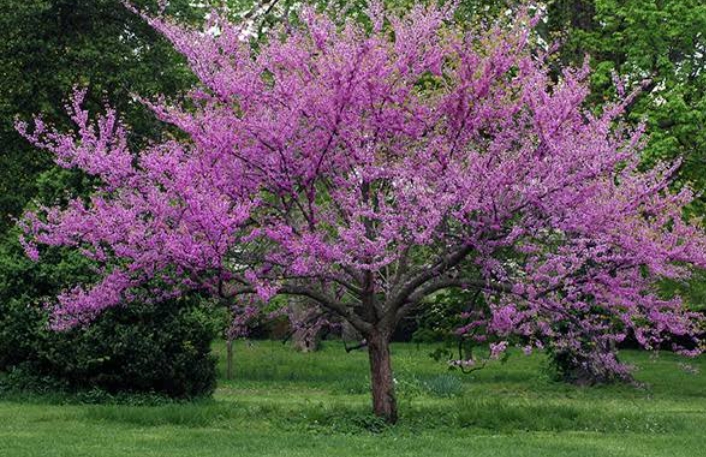
The Eastern Redbud is a deciduous tree native to North America growing to a height of 20 to 30 feet with a spreading, rounded crown. This tree is moderately fast growing, becoming about 7 to 10 feet tall and 15 to 35 feet wide by age 5 or 6.
The tree’s heart-shaped leaves are reddish-purple when young, but slowly become dark green and turn yellow in fall. It a highly adaptable species to different soil types, including alkaline and clay soils, and is drought-tolerant once established. The other best thing about this tree, is that it can be grown as a single specimen or in groupings.
The eastern redbud tree usually flowers in early spring before leaves emerge and continues blooming for 2 to 3 weeks. Hundreds of magenta buds appear in clusters on all the tree’s bare branches, eventually opening as tiny, deep purplish-pink flowers. Each flower is approximately 1 inch in diameter.
Desert Willow
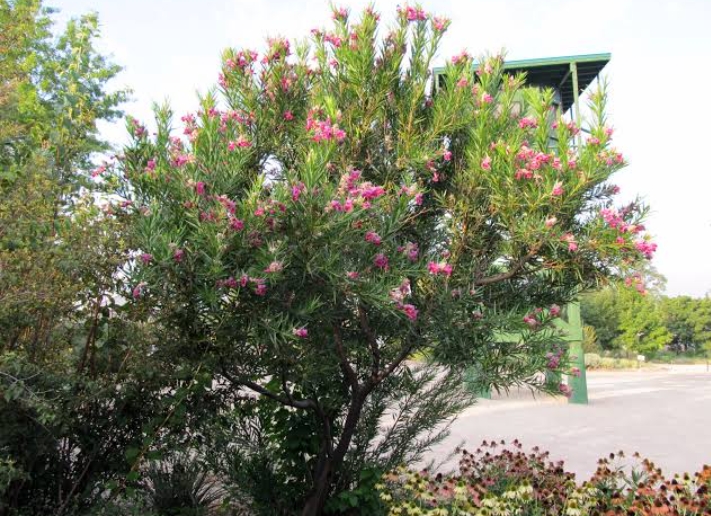
Desert Willow is a fast-growing deciduous tree that can grows between 15 and 30 feet tall with a spreading, irregular crown. It has large, green, lance-shaped leaves that can reach up to 8 inches in length. It is a member of the Bignoniaceae family and is not closely related to willows (Salix species), despite its name.
Desert willow hails from Mexico and the American southwest, growing from California east to Texas. The tree occurs naturally in desert washes and desert grasslands, often occurring at low elevation alongside streams.
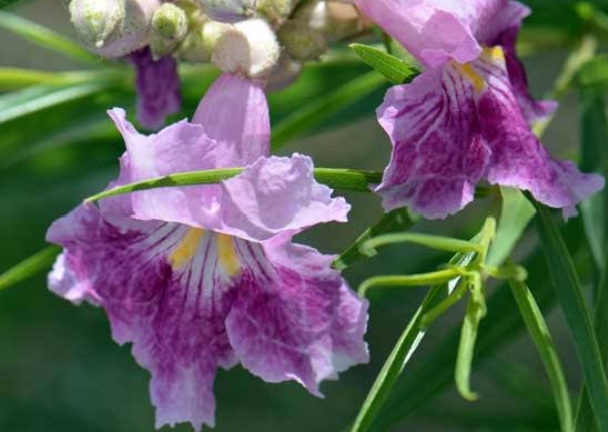
Desert willow explodes into bloom in late spring and continues into early autumn, attracting bees with its nectar. The flowers are trumpet-shaped and range in color from pink to purple. The flowers are produced in clusters and have five petals that are fused together at the base.
Lilac Bush Tree
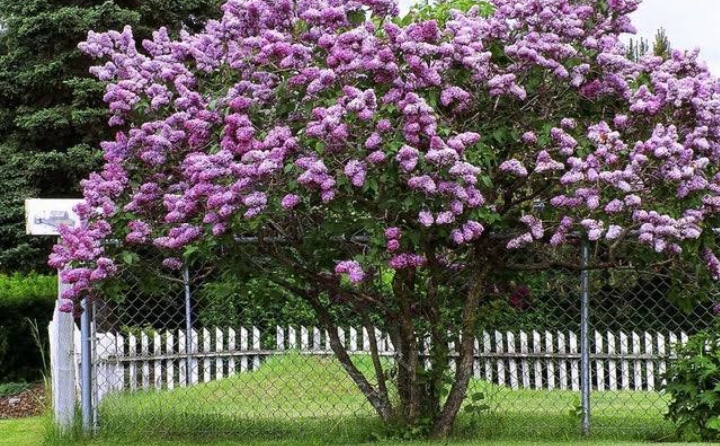
Lilac bush is large upright and densely branched deciduous shrub that is native to southeastern Europe and southwestern Asia. This shrub can be grown as standalone specimens or in a group for a mass display of flowers. On average, mature lilac shrubs range in height from 8 to 20 feet and in width from 6 to 12 feet.
The flowers grow in large clusters or panicles, and can be anywhere from 4 to 12 inches long. Each flower has a tubular shape with a flared opening. The flowers are usually in the shade of purple or lavender. They are generally very fragrant with a sweet, floral scent that is often described by many garden enthusiasts as intoxicating. For sure, the fragrance can fill a whole garden.
Wisteria Tree
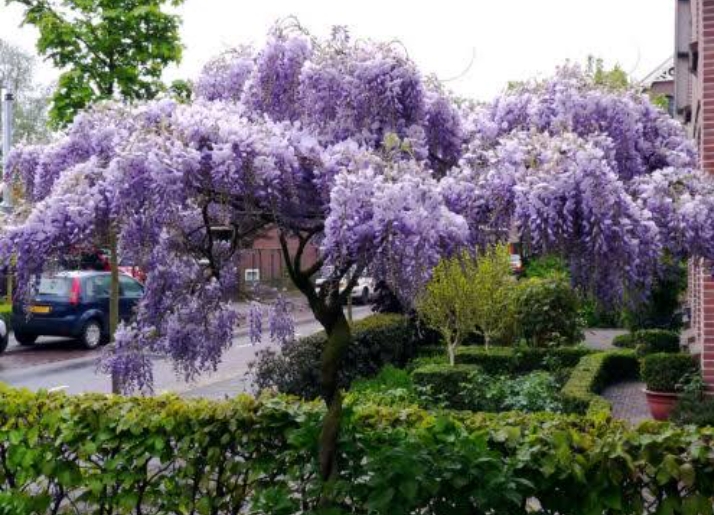
Wisteria is native to Asia, but has been widely introduced to other parts of the world, including North America and Europe. It is generally not a tree but woody vine that climbs. It can climb as high as 20 m 66 ft above the ground and spread out 33 ft laterally.
Wisteria when vibrantly growing will certainly provide a lush, green canopy in the summer and a spectacular display of flowers in the spring. It is often trained to grow on trellises, arbors or pergolas. Wisteria too can be pruned and trained to grow in compact form as a bonsai or a small shrubby tree in the garden or containers.
Wisteria flowers are long and in hanging clusters. They will often appear in the early spring to late autumn. The flowers are usually purple or pink but depending with the soil pH, though they can still can be light blue in color. The flowers are usually arranged in racemes, which can be up to 60 cm long and contain hundreds of individual flowers. The blooms too are highly fragrant and the scent can be overpowering when in large quantities.
Hong Kong orchid tree
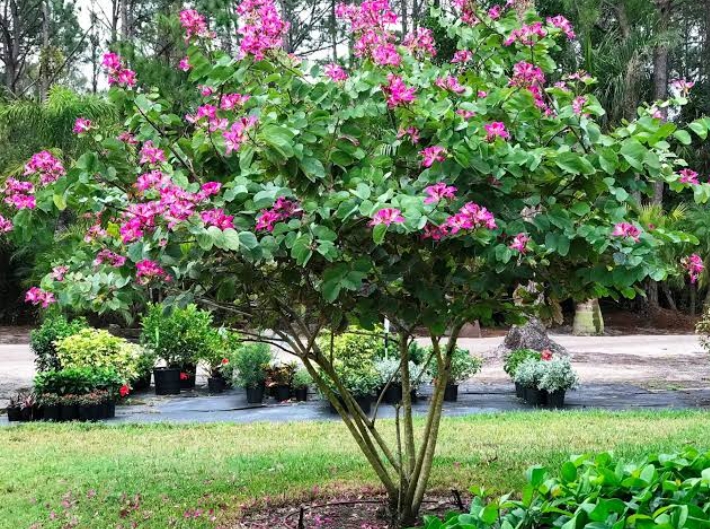
Hong Kong orchid tree, also referred to as Purple Orchid tree is native to Southeast Asia, but has been introduced to many other regions throughout the world, including the Caribbean and the United States. This is basically an evergreen tree that grows to heights of between 15 and 30 feet with a wide-spreading, irregular crown sitting on a thick, sturdy trunk.
The Hong Kong orchid tree’s leaves are broad and flat, with a distinctive shape that resembles a butterfly. Overall, the tree naturally possesses a graceful growth habit, although it must be grown under the right conditions and given the right care early-on to help it look its best.
The fragrant flowers of the Purple Orchid Tree bloom from late winter to early spring and are large, showy with an orchid-like in appearance. The flowers are about 4 inches in diameter and have a unique, bilateral symmetry, with two large, purplish-pink to reddish-purple petals and a central cluster of yellow stamens. The petals are thin and delicate, and are often veined with darker purple markings.
Purple Glory Tree
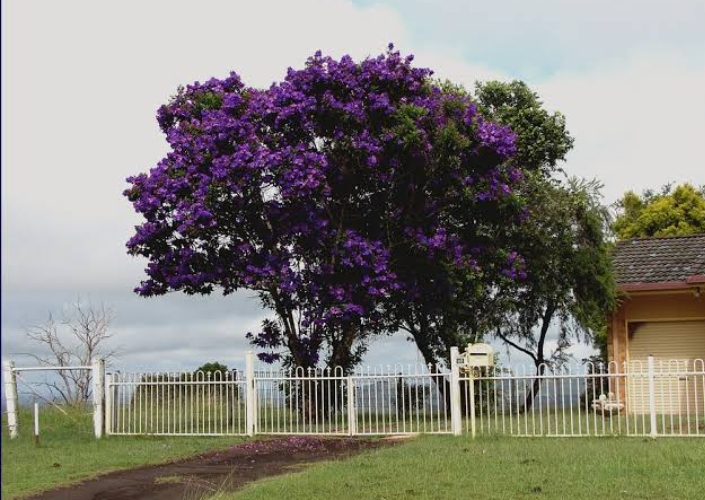
The Purple Glory Tree, also known as the Princess Flower or Glory Bush, is a tropical evergreen shrub or small ornamental tree featuring large flowers. In very many places it grows to a height of 10 to 15 feet and can spread up to 15 feet or more, creating a sprawling form. The leaves are velvet-like, dark green leaves and grow to about 4 inches in length. Though this small tree is tropical in nature, it is somewhat hardier than many other tropical plants.
The flowers of the Purple Glory Tree are small in size, growing in clusters along the branches. They are rosy-pink in color, with a purplish tinge, and they are very attractive to pollinators such as bees and butterflies. The good thing about this tree is that it blooms intermittently throughout the year.
The purple robe locust
The Purple Robe Locust tree is a cultivar of the black locust tree, native to North America. It is a medium-sized deciduous tree that grows to a height of 25 and 50 feet. It grows in an upright, irregular oval shape. The tree’s bark is furrowed and so dark a gray that it looks almost black.
When they first emerge in the spring, the leaves of the purple robe trees have a reddish-purple tinge. They eventually mature to a dark green and turn yellow in the fall. The seeds of the tree are found inside pods that are 3 to 4 inches long.
It is hardy in USDA zones 4 to 8. The roots and seeds of the purple robe tree spread so aggressively that it is considered invasive. In the spring, usually in May through early June, the purple robe locust tree produces fragrant pinkish-purple flowers on hanging racemes that may be up to 8 inches in length.
Texas mountain laurel
Texas mountain laurel also known as mescal bean is a small tree that is native to Texas and Mexico. It can grow up to 20 feet tall with a canopy spread of 8 to 10 feet. This is a slow-growing tree that can take many years to reach maturity. Foliage is an attractive dark green color and relatively large.
it’s hardy in U.S. Department of Agriculture plant hardiness zones 7 through 11. This means that it can tolerate temperatures as low as 0°F to 10°F (-18°C to -12°C) and can be grown in areas with these minimum temperatures without suffering significant damage.
The flowers are bell-shaped with several blooms growing together on a single stem. They can be deep purple to violet and approximately 1 to 2 inches in size. The flowers are highly fragrant and have a sweet, pleasing aroma that can be smelled from a distance. The blooming season for the Texas Mountain Laurel occurs in the spring, from March to April, and lasts for several weeks.
Royalty Crabapple
The Royalty Crabapple is a deciduous tree that is a cultivar of the common crabapple tree (Malus). The tree is native to the northern hemisphere, but the exact origin of the ‘Royalty’ cultivar is not known. This is a small flowering tree with a somewhat spreading habit. It grows between 15 and 20 feet tall and will perfectly fit in any small or medium-sized yard.
This hardy tree thrives in the moderate winters of a Mediterranean climate, as well as climates with colder winters, such as USDA hardiness zone 4 to 8. Although overall these crabapple tree has a good disease resistance, they are somewhat susceptible to apple scab. And therefore, if you consider growing them, you will need to time after time look at their health.
The Royalty Crabapple’s profuse blooms, more often appear in the spring before the leaves. The blooms are Red-purple or pink-purple with a slight fragrance. After flowering, a red fruit approximately 1 inch in diameter, will appear. The fruit is not eaten by humans but provides an important food source for wildlife, such as birds and squirrels.
Empress tree
Empress tree also referred to as with common names princess tree or foxglove-tree is a fast-growing deciduous tree that is native to central China. The Empress tree can reach up to 50 feet tall with an irregular round or vase shaped crown. Its trunk that can be as wide as 5 feet in diameter. The tree is widely cultivated in Asia for its valuable wood, which is lightweight, strong, and resistant to decay.
The blooms of empress tree have a vanilla scent and are pale pink or lavender in color. The flowers are shaped like trumpets and hang in beautiful clusters. They resemble those of foxglove (Digitalis spp.), and are speckled with dark purple and accented with streaks of yellow. Large, slightly hairy leaves, which can reach up to 12 inches in length, provide a nice backdrop to the blooms. In the fall, the tree sheds its woody seed pods, releasing winged seeds into the air.
The Empress tree is hardy in USDA hardiness zones 5 through 9, meaning it can grow and survive in areas with minimum winter temperatures averaging from minus 20 to 20 degrees Fahrenheit. This is a highly adaptable tree that can grow in various soils, from dry to moist.
Takasago Flowering Cherry
Takasago is a cultivar of flowering cherry that originated in Japan. The tree can grow to be 15 feet tall or more with a wide-spreading or open crown and a dense canopy of branches. The leaves are simple with serrated edges. The branches of Takasago cherry tend to be somewhat brittle when young, but they become more robust as the tree matures.
The tree has dark green deciduous foliage which emerges coppery-bronze in spring. The pointy leaves turn beautiful red in the fall. The tree grows at a medium rate, and under ideal conditions can be expected to live for 50 years or more.
The blooms of Takasago cherry are among the earliest of all flowering cherries, appearing before the leaves emerge in early to mid-spring. The flowers are usually one of the first signs of spring in some places in North America. The flowers of the Takasago are usually purple-pink in color, with a range of shades from light purple to deeper pink hue. They are purple about 1 inch in diameter, and have five petals that are held in loose clusters on the tips of the branches.
The Royal Purple Smoke Tree
The Royal Purple Smoke Tree is a cultivar of the smoke tree native to the Mediterranean region and the Caucasus Mountains. It is a small deciduous tree that can grow up to 15 feet tall with a spreading crown. This is a beautiful tree, and many people North America love it so much for the visual interest it adds to the home garden by creating the illusion of purple smoke as a result of its wispy flowers produced in spring and early summer.
The flowers of the Royal Purple Smoke Tree are plume-like clusters. These clusters consist of tiny, inconspicuous flowers surrounded by larger, showy bracts. The bracts can be pink to purplish-pink, creating a striking contrast against the dark purple leaves of the tree. After flowering, fluffy seed heads emerge. This tree is hardy in USDA hardiness zones 4 to 8.
Cork Bush Tree
Cork bush tree also referred to as Mundulea is a small tree native to tropical and subtropical regions of Africa including Madagascar and the Comoros Islands. It grows to about 15 feet in height with a spread growth habit. The leaves are simple, pale grey with a prominent midrib and embedded with fine silver hairs. The branches and trunks feature a cork-like bark which is where its common name comes from.
The tree produces relatively small, conspicuous flowers that are pure purple or light purple in color. The flowers are arranged in clusters and are surrounded by small scale-like leaves. The flowers are often produced during spring, that is between April and May, though if well cared for it can produce flowers twice or thrice in a year. This species is neither heat nor cold tolerant and it won’t do well in places with sub-zero temperatures.
Malabar Rosewood
Native to the Indian subcontinent, this large, elegant timber tree produces clusters of small but charming purple and pale violet pea-like flowers that emerge in the dry season.
While it is globally celebrated for its exceptionally hard, fragrant heartwood — used in fine furniture and musical instruments — its flowering season reveals a softer, more ornamental side. In full bloom, it fills the surrounding air with a subtle, sweet fragrance unique among rosewood species.
Purple Orchid Tree
Native to Southeast Asia, the Purple Orchid Tree earns its name from its orchid-like flowers, which display five richly veined petals in shades of pink, lavender, and deep purple.
It blooms from autumn through winter, making it a valuable ornamental when many other trees are dormant. Its distinctive twin-lobed leaves — resembling a butterfly or a camel’s hoof — are iconic and instantly recognizable. It is the floral emblem of Hong Kong.
Tibouchina
Often called the Princess Flower or Glory Bush, Tibouchina is a Brazilian native that produces strikingly vivid, rich violet-purple flowers with a velvety texture. In warm climates it can grow into a small tree, blooming almost continuously from summer through autumn.
Its large, softly hairy leaves have prominent veining, and the bold contrast of deep green foliage against electric purple blooms makes it one of the most visually arresting trees in any tropical or subtropical garden.
Purple-Leaf Ornamental Plum
The Purple-Leaf Plum is a small, eye-catching ornamental tree that produces delicate pale pink to soft purple blossoms in early spring, often before the leaves emerge.
What makes it doubly dramatic is its deep burgundy-purple foliage, which persists throughout the growing season, creating a stunning year-round contrast in the landscape. Native to Western Asia, it is now one of the most widely planted ornamental street trees across temperate regions of the world.
Purple Trumpet Tree
One of the most breathtaking flowering trees of the Americas, the Purple Trumpet Tree is native to the tropical and subtropical forests from Mexico down to Argentina.
It produces an explosion of rich magenta-purple, trumpet-shaped flowers directly on its bare branches in late winter and spring — before a single leaf appears — creating a spectacle of pure, uninterrupted colour. It is the national tree of Paraguay and a prized ornamental across warm regions worldwide.
Purple Magnolia
Also called the Mulan Magnolia or Lily Magnolia, this small Chinese tree is one of the parents of the famous Saucer Magnolia and produces elegant, tulip-shaped blooms in deep rose-purple on the outside and creamy white within.
It blooms in early spring and may produce a secondary flush later in the season. Its compact size, refined form, and extraordinarily beautiful flowers have made it a cornerstone of ornamental gardening since ancient China, where it was cultivated for over a thousand years.
Purple Robe Locust
A cultivar of the Black Locust, the Purple Robe is a fast-growing, ornamental tree that produces dense, pendulous clusters of fragrant, rose-purple flowers in late spring — an unusual trait for a locust tree, whose species typically bears white blooms.
Its dark bronze-green, pinnate foliage provides a rich backdrop that intensifies the colour of the flowers. It is highly adaptable, tolerating poor soils and urban pollution, making it a popular choice for difficult planting environments.
Persian Silk Tree
The Persian Silk Tree, native from Iran to Japan, produces extraordinary fluffy, powder-puff blooms composed of masses of long, silky stamens in shades of pink, rose, and soft purple — a flower unlike almost any other tree in the temperate world.
It blooms through summer and into early autumn, and its feathery, fern-like foliage folds up at night, giving it a mysterious, animated quality. Its wide, spreading, flat-topped canopy makes it a magnificent shade tree as well as a flowering spectacle.
Chitalpa
The Chitalpa is a rare and beautiful hybrid between the Desert Willow (Chilopsis linearis) and the Catalpa (Catalpa bignonioides), first bred in Tashkent, Uzbekistan.
It combines the best traits of both parents, producing large clusters of frilly, orchid-like flowers in lavender, pink, and purple throughout summer. It inherits the drought tolerance of the Desert Willow and the bold foliage of the Catalpa, making it one of the most garden-worthy flowering trees for hot, dry climates.
Foxglove Tree
A close relative of the more famous Empress Tree, Paulownia elongata produces similarly spectacular clusters of pale violet, foxglove-shaped flowers in spring, but tends to be slightly more slender and refined in habit.
Native to China, it is celebrated for its extraordinary growth rate — capable of growing several metres in a single year — and its enormous, felted leaves that give it a bold, tropical character. The flowers appear before the leaves and are faintly vanilla-scented.
Blue Potato Bush (Solanum rantonnetii)
Native to Paraguay and Argentina, the Blue Potato Bush can be trained into a small standard tree and produces a nearly continuous display of rich violet-blue flowers with a golden yellow centre throughout the warm months.
A member of the nightshade family, it is closely related to the tomato and potato, which explains the distinctive star-shaped form of its blooms. In frost-free climates it grows vigorously and is beloved for its long blooming season and vivid flower colour.
Chinese Redbud (Cercis chinensis)
The Chinese Redbud is the Asian counterpart to the Eastern Redbud and produces similarly stunning clusters of vivid rosy-purple flowers directly from its branches and trunk in early spring.
Native to central and eastern China, it tends to be smaller and more shrub-like than its American cousin, but can develop into a graceful small tree over time. The flowers emerge in such density that branches and stems appear to be wrapped in jewel-like beads of purple and rose, creating a truly spectacular spring display.
Golden Dewdrop (Duranta erecta)
Native to tropical America, the Golden Dewdrop is a versatile plant that can be shaped into a small flowering tree and produces delicate, five-petalled flowers in violet-blue and purple with a white fringe — elegantly small and numerous, borne in arching racemes.
The flowers are followed by strings of golden-yellow berries that appear simultaneously with new blossoms, creating a vivid two-tone display. It is a favourite in tropical and subtropical gardens for its near-continuous blooming habit.
Japanese Pagoda Tree (Styphnolobium japonicum)
Despite its name, the Japanese Pagoda Tree is actually native to China and Korea and was historically planted extensively around Buddhist temples and imperial palaces across East Asia — hence the association with Japan.
In late summer, it produces large, creamy-white to pale lilac flower clusters that give way to distinctive necklace-like seed pods. It is one of very few large trees to bloom in late summer, making it exceptionally valuable in the landscape when most other flowering trees have long finished.
Vitex negundo (Five-Leaved Chaste Tree)
A close cousin of the more common Chaste Tree, Vitex negundo is native to Africa and Asia and produces elegant, tapering spikes of small but richly coloured lavender-purple flowers throughout summer and into autumn. Its aromatic, deeply divided leaves have been used in traditional medicine across many Asian cultures for thousands of years.
It is a fast-growing, adaptable tree that thrives in hot, dry conditions and is particularly valued in South and Southeast Asian landscaping for its graceful form and long flowering season.
Harlequin Glorybower (Clerodendrum trichotomum)
Native to China and Japan, the Harlequin Glorybower is a small tree or large shrub that produces clusters of intensely fragrant, star-shaped flowers with white petals emerging from vivid rose-red calyces in late summer — the overall effect shimmering between purple-pink and white.
As the flowers fade, they are replaced by striking turquoise-blue berries nestled within their persistent red calyces, creating one of the most dramatic fruit displays in the plant kingdom. It is a tree of perpetual surprises throughout its season.
Purple Wisteria Tree (Wisteria floribunda ‘Violacea Plena’)
While standard Wisteria is already included in this list, the double-flowered Japanese Wisteria ‘Violacea Plena’ deserves its own recognition. This cultivar produces uniquely full, double-flowered clusters in deep violet-purple, with a richer, more intensely coloured bloom than the common species.
When trained into a standard tree form, it creates a weeping column of cascading double purple clusters that is among the most theatrical sights in any spring garden. Its fragrance is equally extraordinary — heady, sweet, and enveloping.
Sea Lavender Tree (Limonium arborescens)
Native to the Canary Islands, this rare and beautiful small tree produces broad, airy panicles of tiny, papery flowers in soft lavender-purple from spring through summer.
Unlike many flowering trees, its blooms retain their colour even when dried, making it a prized specimen in both the garden and the floral industry. It thrives in coastal conditions, tolerating salt spray and wind with ease, and its silvery-green foliage provides a lovely contrast to the haze of purple flowers above.
Adventurer’s Tree / Hong Kong Orchid Tree (Bauhinia blakeana)
More vibrant and showier than the Purple Orchid Tree listed earlier, Bauhinia blakeana — the Hong Kong Orchid Tree — is a sterile hybrid that produces its spectacular deep magenta-purple, orchid-like flowers almost continuously from late autumn through spring.
Because it cannot set seed, all its energy goes into extraordinary floral production. It is the floral emblem of Hong Kong, depicted on the city’s flag and coins, and is considered one of the most beautiful flowering trees ever introduced to cultivation.
Pride of Burma (Amherstia nobilis)
Considered by many botanists and horticulturalists to be the most beautiful flowering tree in the world, the Pride of Burma is native to Myanmar and produces breathtaking, pendulous clusters of orchid-like flowers in deep crimson and gold — shading toward rose-purple at the edges — that hang from the branches like living chandeliers.
New leaves emerge in a remarkable flush of coppery-pink, hanging limp and silken before hardening to green. It is extraordinarily rare in cultivation outside the tropics and is treated as a precious treasure wherever it successfully grows.
Koelreuteria bipinnata (Chinese Flame Tree)
While the Chinese Flame Tree is most famous for its lantern-like, rosy-pink seed pods, it produces attractive clusters of small yellow flowers in summer that are followed by those extraordinary purple-flushed pods, which colour the entire canopy in shades of rose, salmon, and purple for months.
Native to southern China, it is a medium-sized tree with elegant, twice-divided foliage and a refined, airy canopy that makes it an excellent ornamental specimen for parks and large gardens.