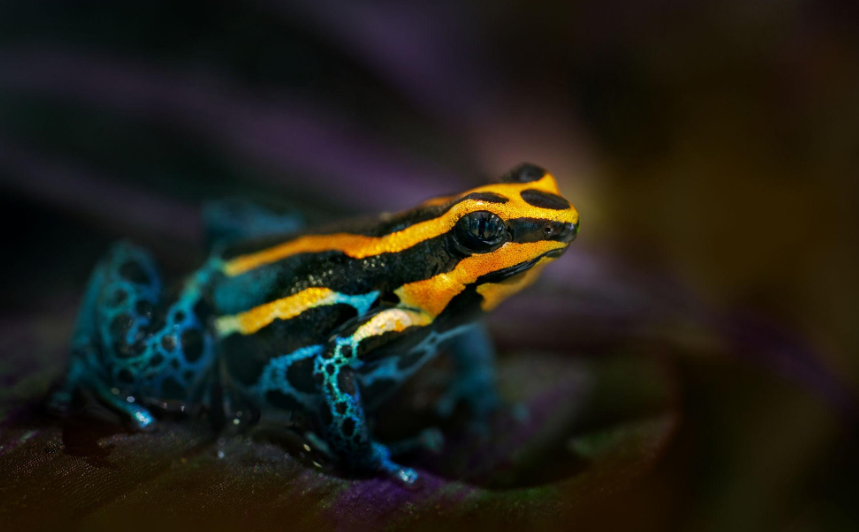
Frogs that live in the Amazon Rainforest are among the most diverse and colorful amphibians in the world. The Amazon’s warm temperatures, heavy rainfall, and dense vegetation create ideal conditions for frogs to thrive. These frogs can be found at every level of the forest, from the damp ground to the high canopy.
Many Amazon frogs are known for their bright and striking colors. Some display vivid shades of blue, yellow, red, or green, often as a warning to predators that they may be toxic. Others rely on camouflage, blending into leaves, bark, or moss to avoid being seen. This wide range of appearances reflects the many survival strategies found in the rainforest.
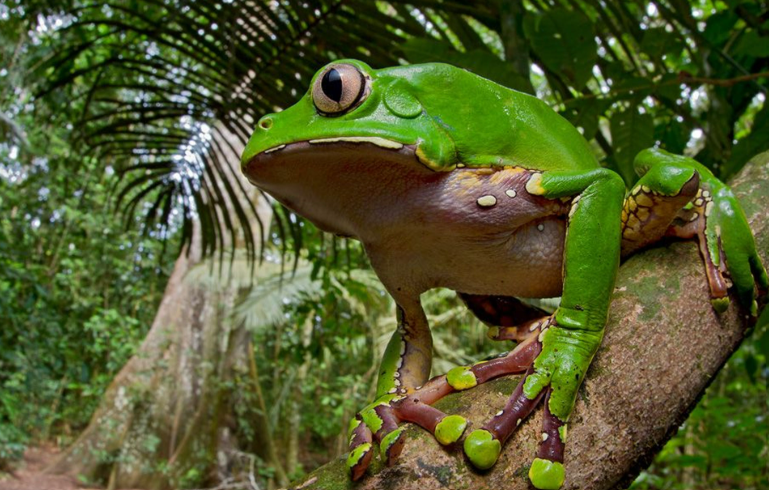
Tree-dwelling frogs are especially common in the Amazon. These frogs have sticky toe pads that allow them to climb and cling to branches and leaves. They often live near water-filled plants or small pools where they can lay eggs. Living above the ground helps them avoid many predators and access new food sources.
On the forest floor, larger and more heavily built frogs can be found. These frogs often rely on camouflage and ambush hunting, waiting quietly for insects or small animals to pass by. Some have wide mouths and powerful jaws, allowing them to eat a variety of prey, including other frogs.
Reproduction in the Amazon is incredibly varied. Some frogs lay eggs in water, while others place them on leaves above water so the tadpoles drop in after hatching. There are even species that carry their eggs or tadpoles on their backs to protect them. These unique methods increase the chances of survival in a competitive environment.
Frogs that Live in the Amazon Rainforest
Red-Eyed Tree Frog (Agalychnis callidryas)
The most iconic frog on Earth, the Red-Eyed Tree Frog dazzles with its vivid green body, shocking scarlet eyes, blue-striped flanks, and orange feet.
It lays eggs on leaves overhanging water, and when tadpoles hatch they drop directly into the pool below. Its startling red eyes serve as a defense mechanism — a flash of unexpected color that freezes predators long enough for the frog to escape.
Amazon Milk Frog (Trachycephalus resinifictrix)
Named for the white, milky defensive secretion it produces when stressed, this large canopy tree frog breeds in water-filled tree hollows high above the forest floor.
Multiple females deposit eggs in the same hollow, and the developing embryos feed on unfertilized eggs provided by attending mothers. Its bold black-and-white juvenile patterning gradually softens into the muted grey tones of adulthood.
Golden Poison Dart Frog (Phyllobates terribilis)
The most toxic vertebrate on Earth, this small golden frog from Colombia’s Pacific coast carries enough batrachotoxin to kill ten adult humans through skin contact alone.
Indigenous Emberá people traditionally wiped blowgun darts across its back to harvest the toxin. In captivity, without its wild diet of toxic beetles and specific ants, it gradually loses all toxicity over successive generations.
Dyeing Poison Dart Frog (Dendrobates tinctorius)
One of the largest and most variable of all dart frogs, this Guiana Shield species comes in a staggering array of color morphs — blue, yellow, white, black, and every combination imaginable — with populations just kilometers apart sometimes looking completely different.
A legend — likely apocryphal — claims indigenous peoples rubbed the frog on young parrots to cause their feathers to regrow in unusual colors, hence the name “dyeing.” It is widely captive-bred and deeply popular in the dart frog hobby.
Amazon Horned Frog (Ceratophrys cornuta)
Known as the Amazonian Pac-Man Frog, this rotund predator spends its life half-buried in leaf litter with only its enormous upward-facing mouth visible, ambushing anything that wanders within range — including mice, lizards, and other frogs.
Its mouth accounts for nearly half its body width, giving it one of the largest gapes relative to body size of any frog. It has primitive teeth on its upper jaw and bites with genuine force.
Phantasmal Poison Frog (Epipedobates tricolor)
This small Ecuadorian frog made medical history when scientists discovered its skin contains epibatidine — a painkiller 200 times more potent than morphine that acts on entirely different receptors, making it of extraordinary pharmaceutical interest as a potential non-addictive analgesic.
Its bold red or maroon striping on a dark background makes it visually striking, and it inhabits the humid western Andean slopes feeding on tiny mites and ants from which it derives its remarkable chemistry.
Paradox Frog (Pseudis paradoxa)
One of the most counterintuitive animals in biology, the Paradox Frog produces tadpoles up to 25 centimeters long — among the largest in the world — that then shrink dramatically during metamorphosis into adults barely a quarter of their tadpole size.
It is highly aquatic, spending its adult life floating among dense mats of vegetation in flooded savannas and lake systems across the Amazon Basin. Its extraordinary size reversal during development remains a subject of ongoing scientific interest.
Smoky Jungle Frog (Leptodactylus pentadactylus)
One of the largest frogs in the Amazon, this powerful nocturnal predator hunts from the edges of rivers, streams, and flooded forest, consuming fish, small mammals, snakes, and other frogs with equal willingness.
Males produce a single, penetrating “whoop” call from the water’s edge that resonates through the night forest. When threatened it secretes a potent skin toxin that causes intense burning in the eyes and mucous membranes of any predator that attempts to swallow it.
Mimic Poison Frog (Ranitomeya imitator)
One of the most scientifically celebrated frogs in evolutionary biology, the Mimic Poison Frog adapts its warning coloration to match whichever more toxic species is dominant in its local area — striped where striped species dominate, spotted where spotted species do.
This geographic color mimicry across a single species’ range has made it a landmark study subject for understanding the evolution of warning signals, predator learning, and the mechanics of speciation in tropical forests.
Glass Frog (Hyalinobatrachium valerioi)
Named for the transparent skin of its underside through which beating heart, digestive organs, and developing eggs are clearly visible, this delicate tree frog inhabits vegetation overhanging fast-flowing Amazonian streams.
Males guard egg clutches by sitting directly on them — shielding them from predatory wasps and keeping them moist with their bodies. Research has revealed their vivid green color is partly achieved by the unusual ability to concentrate red blood cells in the liver, creating a translucency effect.
Blue Poison Dart Frog (Dendrobates azureus)
Endemic to a small, isolated patch of savanna forest in southern Suriname, the Blue Poison Dart Frog’s cobalt blue body marked with irregular black spots has made it one of the most recognizable amphibians in the world and an icon of conservation imagery.
Its restricted range — estimated at only a few hundred square kilometers — makes it acutely vulnerable to habitat disturbance. Males are devoted fathers, guarding egg clutches and carrying tadpoles individually to carefully selected water-filled bromeliads.
Banded Rubber Frog relative / Surinam Toad (Pipa pipa)
The Surinam Toad is perhaps the most anatomically bizarre frog in the Amazon — a completely flat, leaf-shaped aquatic animal whose eggs become embedded in the spongy skin of the female’s back during mating.
After roughly 80 days of development within individual skin pockets, fully formed froglets erupt through the mother’s back one by one — a sight so extraordinary that videos of it regularly stun first-time viewers worldwide. It hunts by vacuuming prey into its toothless mouth with a rapid suction strike.
Tiger-Legged Monkey Frog (Phyllomedusa tomopterna)
This canopy-dwelling waxy monkey frog gets its name from the bold orange-and-black barring on its inner thighs, revealed when it moves.
It produces a waxy lipid secretion from specialized skin glands and spreads it methodically over its entire body using its legs — a remarkable waterproofing behavior that prevents dehydration on exposed canopy leaves under the tropical sun. Its deliberate, hand-over-hand climbing movement gives it the primate-like gait that names the entire monkey frog group.
Reticulated Poison Frog (Ranitomeya ventrimaculata)
One of the smaller Ranitomeya species at barely fifteen millimeters, this vivid red, orange, or yellow frog with fine black reticulated patterning inhabits the leaf litter and low vegetation of western Amazonian primary forest.
It is a biparental species — both male and female participate in tadpole transport and care — an unusual level of shared parental investment that has made Ranitomeya frogs important models for studying the evolution of social behavior in amphibians. Its intense coloration warns predators of its moderate but real alkaloid defenses.
Knudsen’s Frog (Leptodactylus knudseni)
One of the largest terrestrial frogs of the Amazon forest floor, Knudsen’s Frog is a powerful, heavily built predator capable of taking prey items far larger than typical frogs attempt — including small vertebrates and large arthropods that venture within range of its considerable gape.
Males produce a loud, resonant call that carries through dense Amazonian understory vegetation, and they create foam nests in burrows or depressions in the soil to protect their eggs from the desiccating conditions of the forest floor between rain events.
Harlequin Poison Frog (Oophaga histrionica)
Found in the extraordinarily biodiverse Chocó region bordering the Amazon Basin’s western edges, the Harlequin Poison Frog is one of the most polymorphic vertebrates known to science — populations just a few kilometers apart can display radically different color patterns, from white-on-black to red-on-black to orange-spotted.
This exceptional color variation within a single species has made it one of the most intensively studied frogs in evolutionary biology, serving as a natural laboratory for understanding how visual signals drive speciation and predator avoidance learning.
Strawberry Poison Dart Frog (Oophaga pumilio)
Famous for its extraordinary color variation — over thirty distinct morphs ranging from classic red-and-blue to all-yellow, green, and white-spotted forms — this devoted mother carries individual tadpoles to separate bromeliad pools and returns repeatedly to feed each one with unfertilized trophic eggs until metamorphosis is complete.
Its intense parental investment in each individual offspring is among the highest of any frog, and the mechanisms by which females track and provision separate tadpoles in different locations has been the subject of extensive behavioral research.
Pumpkin Toadlet (Brachycephalus ephippium)
This brilliantly orange miniature frog from Brazil’s Atlantic rainforest fringe is so extremely small — barely one centimeter — that it has lost the physical capacity to hear its own calls, its inner ear structures having been lost through the constraints of radical miniaturization.
It compensates with elaborate visual foot-flagging displays visible to rivals even when its vocalizations go completely undetected. Its vivid orange coloration warns predators of skin toxins, and its tiny size allows it to exploit microhabitats unavailable to larger competitors.
Amazon Leaf Frog (Cruziohyla craspedopus)
The Amazon Leaf Frog is a master of camouflage, its body edged with irregular skin flaps that break up its outline against leaves and bark while its upper surface replicates the texture, color, and venation of dried foliage with extraordinary fidelity.
It spends daylight hours completely motionless in the forest understory of Peru, Ecuador, and Brazil, becoming active at night to hunt insects among the vegetation. Its camouflage is so effective that it can rest in full daylight on forest vegetation and remain entirely undetected even under close observation.
Four-Eyed Frog (Pleurodema brachyops)
This clever South American frog gets its name from two large, eye-like glands on its rump that closely mimic actual eyes — complete with dark pupils — in a defensive strategy that both startles and misdirects predators.
When threatened, it lowers its head and raises its rear end toward the attacker, presenting the false eyes. The strategy is doubly effective because the same glands that present this visual bluff also release toxic secretions, punishing any predator that overcomes its initial startled hesitation.
Monkey Frog (Phyllomedusa bicolor)
The Giant Monkey Frog is sacred to several Amazonian indigenous peoples who use its potent skin secretions — a complex cocktail of bioactive peptides including dermorphin, phyllocaerulein, and phyllomedusin — in ritual kambo purging ceremonies, applying the secretion to small burns on the skin to induce intense physiological effects.
Scientifically its skin is one of the richest known sources of biologically active compounds, many of which have attracted serious pharmaceutical research interest for their extraordinary effects on the human nervous and digestive systems.